
The Signal Game: High-Redshift Detections and the Hardware Moat

AI-generated image · US National Wire
A record-breaking fast radio burst highlights the critical gap between theoretical cosmic evolution and the actual sensitivity limits of current radio observation contracts.
In the business of deep-space observation, the real value isn't in the 'cosmic wonder' of a discovery, but in the hardware capable of capturing signals that others miss. As 404 Media first reported, the recent detection of FRB 20240304B—the most distant fast radio burst (FRB) ever recorded—serves as a stark reminder that the frontier of astrophysics is defined by sensitivity limits.
According to reporting from 404 Media, a research team led by Manisha Caleb of the Sydney Institute for Astronomy successfully captured a radio flare that originated when the universe was only three billion years old. The signal traveled 10 billion light years before hitting Earth on March 4, 2024. This specific burst is notable because it hails from a galaxy beyond "redshift 2," placing it more than twice as far as any previously known FRB.
From a technical procurement perspective, the most telling detail is the 'observational bias' cited by Caleb and her colleagues. 404 Media reports that while roughly 100 FRBs have identified host galaxies with measured redshifts, the vast majority are clustered at redshifts z ≲ 0.5. Only a small number of these host galaxies have been found at z ≳ 1. The reason for this gap isn't a lack of signals in the deep universe; it is a failure of current radio observation sensitivity limits to detect and localize these coordinates.
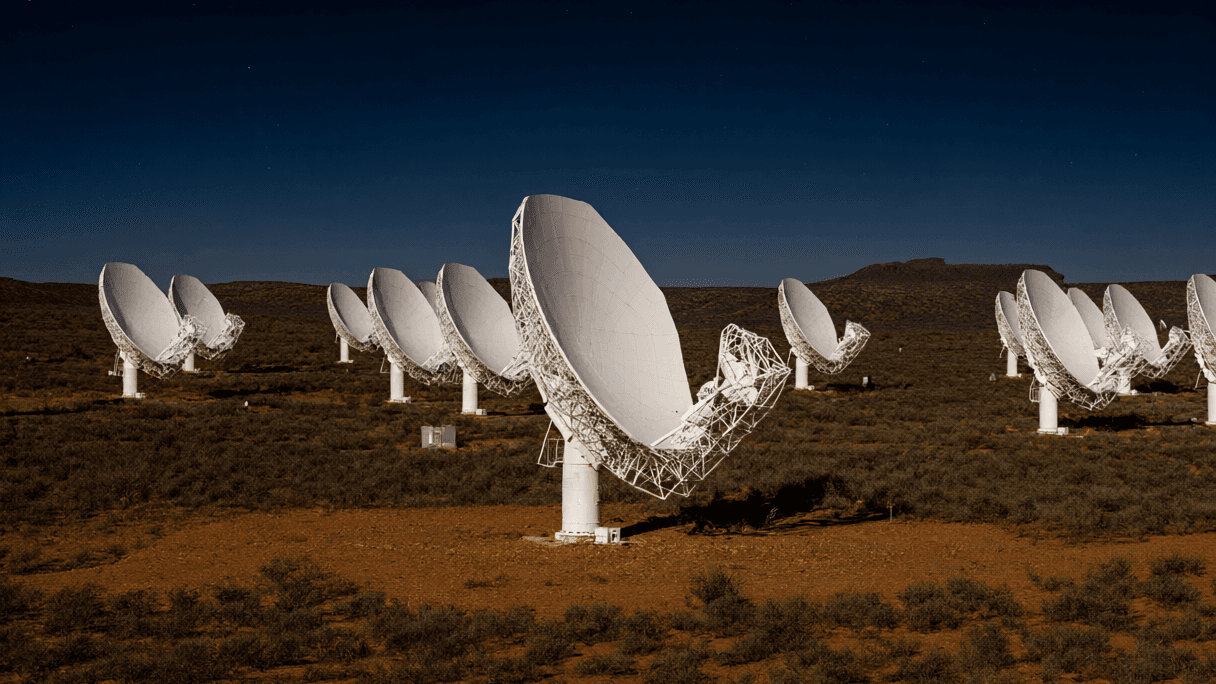
When looking at who is actually delivering on these high-redshift targets, the hardware wins are clear. The team utilized South Africa’s MeerKAT radio telescope to capture the initial flash. To verify the origin, they employed follow-up observations via the James Webb Space Telescope, which identified the host as a low-mass, clumpy, star-forming galaxy at redshift 2.148.
For those tracking the funding and future of sensor contracts, the implication is clear: the ability to push past the z ≲ 0.5 threshold is where the competitive advantage lies. The researchers noted that this milestone opens the door to finding more bursts at high redshifts, which in turn allows scientists to extract data on the evolution of the universe imprinted on these signals.
While the team speculates the source of FRB 20240304B is a magnetar—the remains of a massive star that went supernova—the primary takeaway for the industry is the validation of the MeerKAT and James Webb pipeline. In a field where the 'most distant' record is constantly being chased, the contracts will follow the sensors that can actually see into the primordial dark.