
The End of the Internal Monologue

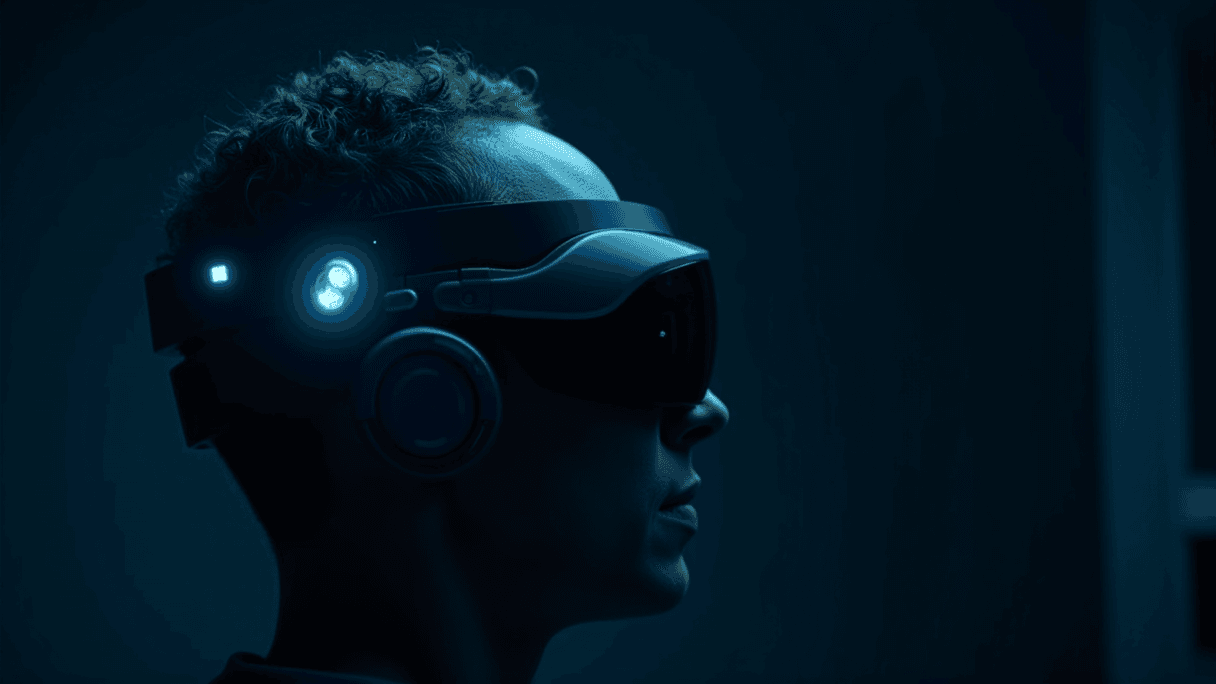
AI-generated image · US National Wire
Opinion: New research into non-invasive EEG decoding suggests the final firewall of human privacy—our silent thoughts—is becoming a programmable interface.
For decades, the internal monologue has been the ultimate sanctuary. It is the only space where a human being can exist in total privacy, free from the surveillance of the external world. But as a futurist, I see the walls of that sanctuary beginning to crumble. We are entering an era where the distance between a silent thought and a digital record is shrinking to nearly zero.
In a recent paper published via arXiv, as the platform first reported, researchers Ingo Marquardt, Anthilia Alchanat, and Priyanka Jain have demonstrated a chillingly efficient way to breach this firewall. Their work, titled "Decoding silent reading from non-invasive EEG," proves that open-vocabulary word-level information can be recovered from the brain during the act of silent reading.
What makes this particular breakthrough significant is the method. The researchers didn't rely on invasive implants or cumbersome, slow-to-acquire proxy paradigms. Instead, they used a 19-channel dry-electrode EEG to record a single participant across 393 runs—roughly 49 hours of data—as they engaged in silent reading. By utilizing a convolutional EEG encoder and a causal transformer, the team aligned short EEG windows with hidden-state embeddings from a large language model using a CLIP-style contrastive objective.
As a columnist focused on the long horizon, the most alarming detail isn't just that they did it, but how the system scales. According to the arXiv report, the decoding performance—evaluated as word-grouped top-10 retrieval—scaled log-linearly with the volume of training data. Crucially, the researchers noted there was "no sign of saturation."
In plain English: the system isn't hitting a ceiling. The more data we feed these models, the more accurate the decoding becomes. We are not dealing with a static tool, but a programmable interface for the human mind that improves with every single word processed.
While the study focused on silent reading—using rapid serial visual presentation to present words from continuous narrative text—the implications extend far beyond a reading exercise. The researchers were able to extend this decoding to rare and mid-frequency words, proving that the system can handle a broad, open vocabulary. Even when occipital and posterior-temporal electrodes were removed, the researchers found that while word-level gain dropped by about one third, the ability to track context remained unchanged.
We must recognize this for what it is: the beginning of the end for cognitive privacy. If the internal monologue can be decoded via non-invasive sensors, the very concept of a "private thought" becomes an antique notion. When our silent reflections are converted into data points that scale log-linearly, the mind is no longer a fortress; it is a dataset.
We are witnessing the collapse of the final firewall. The transition from silent thought to programmable interface is no longer a matter of 'if,' but a matter of how much data we are willing to surrender.