
Stop Chasing General Purpose: The Future of AI is Etched in Silicon

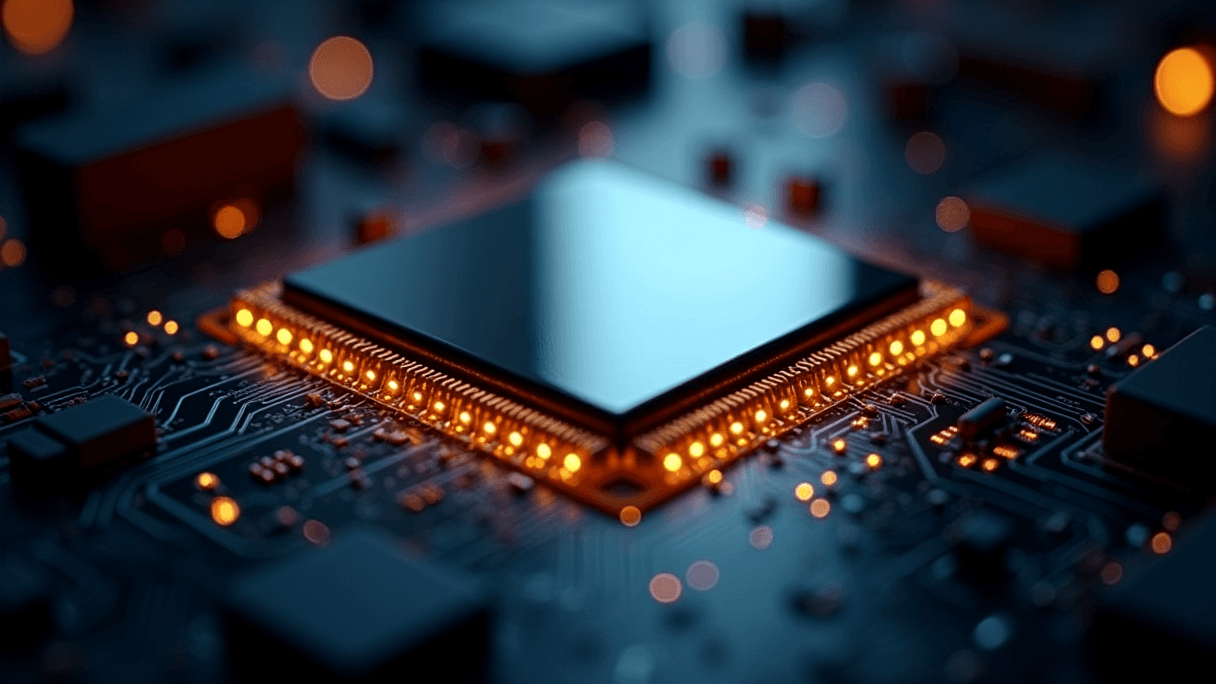
AI-generated image · US National Wire
Opinion: To achieve true industrial-scale performance, we must move past software-defined flexibility and embrace model-specific integrated circuits.
For years, the AI industry has been obsessed with the 'general-purpose' promise—the idea that a handful of massive GPU clusters can handle any model we throw at them. But as we push toward actual industrial-scale deployment, the overhead of that flexibility is becoming a liability. If we want AI agents and code assistants to be truly viable, we need to stop treating the chip as a blank slate and start treating the model as the blueprint.
This is why AMD's recent acquisition of the Toronto-based startup Taalas is the most consequential move in the hardware space right now. As first reported by The Register, Taalas doesn't rely on the standard High Bandwidth Memory (HBM) to store model weights. Instead, it etches them directly into the silicon. These aren't just AI chips; they are what The Register calls "model-specific integrated circuits" (MSICs).
The performance delta here isn't incremental; it's transformative. The Register notes that Taalas' first test chip, the HC1 (fabbed on TSMC’s 6nm process), served Meta’s Llama 3.1 8B at 16,960 tokens per second. At the time of the February announcement, that was 8.5x faster than Cerebras' accelerators and a staggering 48x faster than Nvidia's GPUs.
Critics will argue that this approach is too rigid. Once a model is etched into the silicon, you are locked in. Any significant change requires a chip re-spin. In a market where new models arrive monthly, that sounds like a death sentence. However, Taalas suggests the process is more agile than it appears, noting that only two layers of metal need to be changed for a re-spin, making it cheaper and faster than starting from scratch.
More importantly, the efficiency gains make the 'rigidity' a fair trade. Taalas is targeting 20 billion parameters for its second-gen HC2 chip. According to The Register, using pipeline parallelism, just 50 of these accelerators could support a trillion-parameter model. This is significantly more power and space efficient than Nvidia’s LPX systems, which would require thousands of Groq LPUs or dozens of GPUs to achieve the same result.
AMD is positioned to turn this into a full-stack reality. Vamsi Boppana, AMD’s SVP of AI, stated that the company is building a platform to give customers "the flexibility to deploy the right compute solutions for every AI workload." The Register suggests a pragmatic deployment path: customers validate models on Instinct accelerators first, then transition to Taalas-based accelerators for high-volume token generation. This disaggregated architecture—using GPUs for prompt processing and MSICs for generation—is how we actually scale.
There is also a massive economic incentive. Speaking with The Next Platform, Taalas suggested that the cost of etching weights into silicon is 100x lower than the cost of training a frontier model. For the heavy hitters—Meta, OpenAI, and Anthropic, all of whom are already Instinct customers—the move toward MSICs is a logical evolution.
If we want AI to move beyond the chat box and into high-performance, low-latency industrial applications, we have to stop pretending that one chip fits all. The real breakthrough isn't more software; it's etching the intelligence directly into the hardware.