
The View From Above: Satellite Data Confirms Europe's Shift to Forced Adaptation

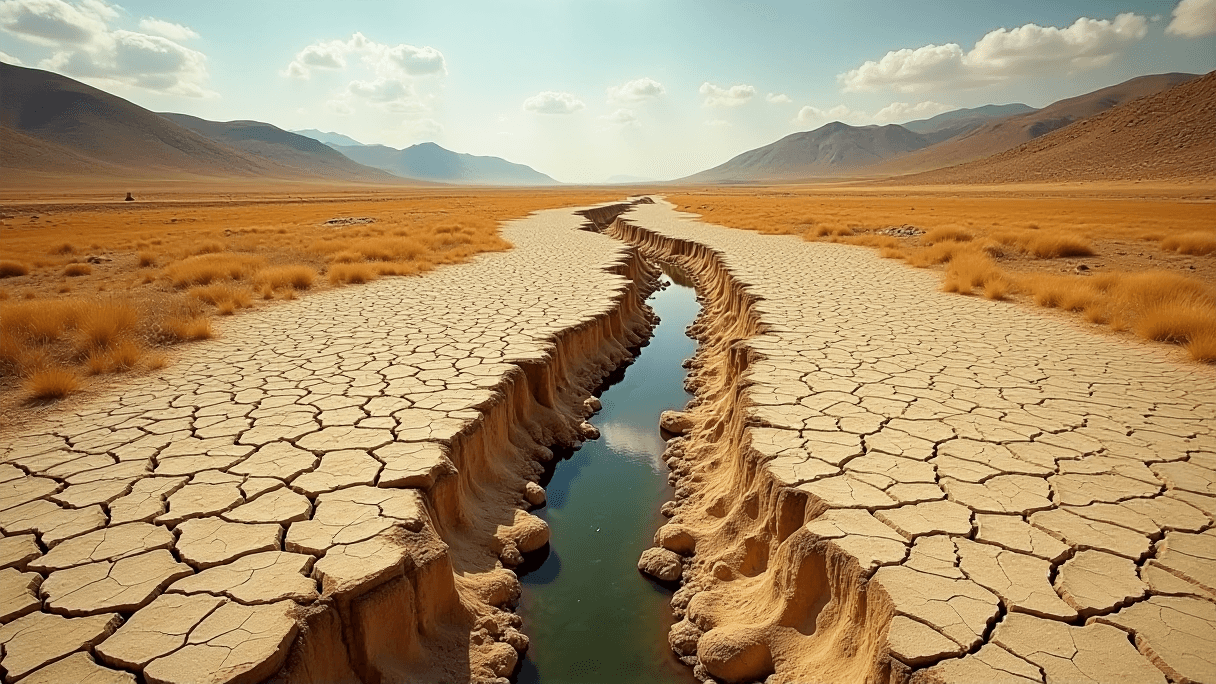
AI-generated image · US National Wire
When the Palace of Versailles looks like an island in a sea of brown, the conversation moves from preventing climate change to surviving it.
For years, the climate conversation has been dominated by the concept of mitigation—the effort to prevent the worst-case scenarios through emissions reductions. But the latest satellite imagery of Western Europe suggests that for many, the 'worst case' has already arrived. We are no longer just planning for a future threat; we are witnessing the forced adaptation of a continent in real time.
Analysis conducted by BBC Verify, as BBC first reported, using Sentinel-2 and Copernicus satellite data reveals a landscape under extreme stress. The imagery shows a stark browning of the land, with the Palace of Versailles appearing as a small island of green surrounded by arid fields. This isn't just a visual anomaly; it is a systemic failure of environmental stability. According to the EU's climate monitoring service, Copernicus, Western Europe just endured its hottest June-to-July period on record.
***
**Opinion: The End of the Mitigation Era**
As a tech columnist, I track deployment. While funding rounds for carbon capture and green hydrogen are essential, the most honest data comes from the sky. When 70% of France, nearly half of the UK, and roughly 40% of Western Germany show vegetation stress below a five-year benchmark (2021–2025), the priority shifts. We have moved past the era where we can simply 'mitigate' our way out of the current heat. The data proves we are now in the era of forced adaptation.
***
This shift is most evident in the collapse of critical infrastructure and natural resources. The Danube, Europe's second-longest river, has hit its lowest levels in 30 years in several countries. The consequences are not merely ecological but operational: nuclear power stations in Romania and Hungary have been forced to reduce capacity or shut down entirely because they cannot pull enough river water for cooling. On the Rhine, the drought has stranded cargo vessels and forced the cancellation of river cruises.
Then there are the glaciers. Dr. Lander van Tricht of the Swiss Federal Institute of Technology notes that climate change has created a cycle of diminished winter snow and accelerated summer melt. Satellite data shows the Rhône Glacier in Switzerland has retreated by 50 meters or more since last year.
Perhaps most alarming is the acceleration of wildfires. The European Forest Fire Information System reports that France is experiencing its worst year on record, with over 90,000 hectares burned. A single fire in the Gironde region near Bordeaux consumed 42,000 hectares. Dr. Douglas Kelley of the UK Centre for Ecology and Hydrology explains that higher temperatures are drying out soils and vegetation faster, making these extreme events more frequent.
From a pragmatic standpoint, the most pressing concern is food security. Prof. Andrew Challinor of the University of Leeds warns that the widespread water stress seen in satellite imagery could severely impact agriculture and food production. Prof. Luis Samaniego of the Helmholtz Centre for Environmental Research adds a grim caveat: in the worst-hit areas, soil moisture is lower than on about 98% of comparable historical dates, meaning that even if the rain returns, some of the agricultural damage may already have been done.
When the landscape itself is rewritten—when rivers vanish and glaciers retreat in a single season—the only metric that matters is how quickly we can adapt to a world that is already here.