
The Interposer Gap: Why the TSMC-GlobalFoundries Deal is the Real AI Infrastructure Story

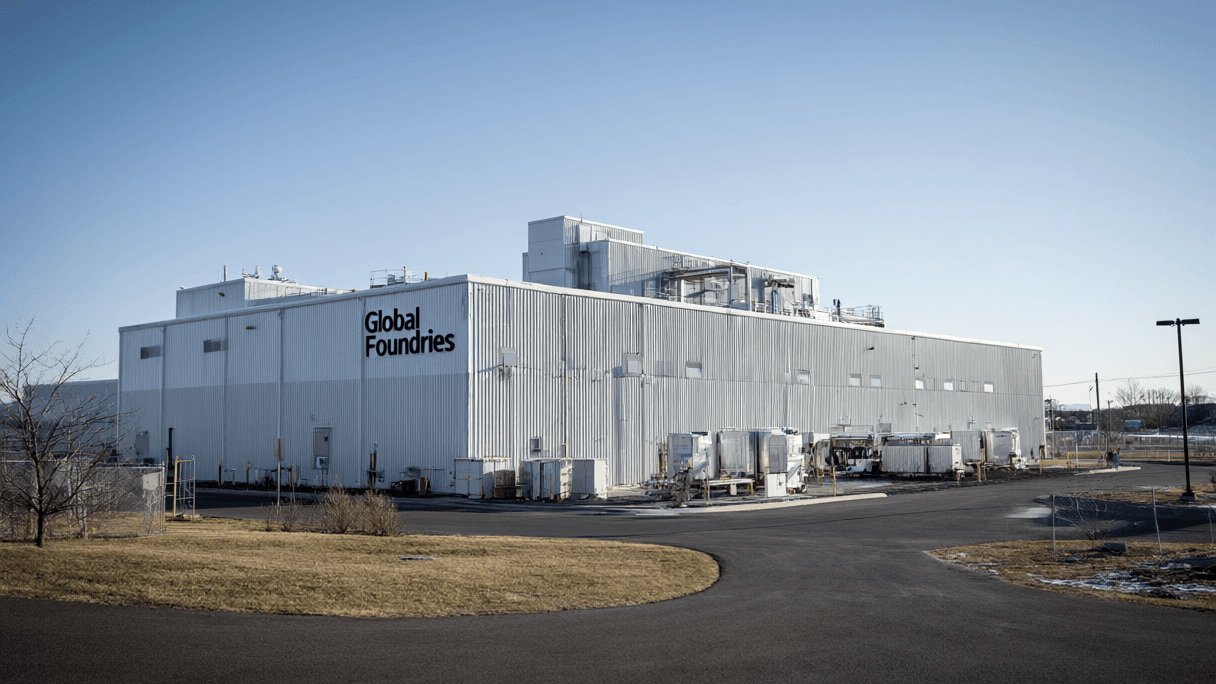
AI-generated image · US National Wire
A $2 billion partnership to produce silicon interposers in New York targets a critical bottleneck in the U.S. semiconductor supply chain.
In the rush to build AI datacenters, the industry often focuses on the compute logic and the memory. But as any builder knows, the architecture is only as strong as the connections. Right now, the U.S. has a physical infrastructure hole in its domestic chip supply chain, and a new $2 billion deal is the first major attempt to plug it.
As The Register first reported, TSMC has partnered with U.S.-based wafer-fab GlobalFoundries to bolster the domestic production of silicon interposers. These parts are essential for TSMC's chip-on-wafer-on-substrate (CoWoS) advanced packaging spec. Without these interposers, the high-performance semiconductors that power AI accelerators and GPUs cannot be assembled into the multi-die configurations required for modern computing.
To understand why this matters, you have to look at the physics. As The Register explains, silicon interposers sit beneath the memory and compute logic, enabling a communication path that is lower in power and higher in speed than conventional organic packaging. Essentially, any chip utilizing high-bandwidth memory (HBM) currently requires an interposer or an interconnect bridge to function.
Until now, the lack of domestic advanced packaging has created a logistical nightmare. The Register notes that when TSMC began producing Nvidia's Blackwell GPUs at its Arizona chip plant last year, the chips still had to be shipped to Taiwan and back to the U.S. for final assembly. This 'round trip' is the definition of an inefficient supply chain.
Under the terms of the new multi-year agreement, GlobalFoundries will produce these interposers at its fab site in Malta, New York. While this is a necessary step toward semiconductor independence, the timeline remains a challenge. GlobalFoundries intends to expand capacity at the Malta plant, but The Register reports that volume production is not expected to start until the first half of 2028 at the earliest. This aligns with a broader lag in U.S. infrastructure; TSMC's own advanced packaging facilities in Arizona and its partnership with outsourced semiconductor assembly and test (OSAT) provider Amkor are not expected to be operational until 2028 and 2029, respectively.
**Opinion:** While the TSMC-GlobalFoundries partnership is a vital signal of intent, the 2028 timeline suggests that the U.S. is still playing catch-up. The real takeaway here is that the 'AI revolution' is not just about software or chip design—it is a grueling exercise in physical plant expansion. If the goal is true domestic resilience, waiting three to four years for volume production is a precarious gamble.
However, there is a potential shortcut. The Register points out that Intel Foundry already provides advanced packaging technology comparable to CoWoS, which is compatible with silicon produced at TSMC fabs. Intel already packages TSMC-made chips in its own facilities. While this requires customers to design parts specifically for Intel's packaging, it represents a viable path for those who cannot afford to wait for the Arizona and New York facilities to come online.
The TSMC and GlobalFoundries deal is slated to last five years, with the possibility of extension. It is a pragmatic move to secure the plumbing of the AI era, but the clock is ticking.