
The Breville Eye Q is a $300 Disco Light That Can't Master Sourdough

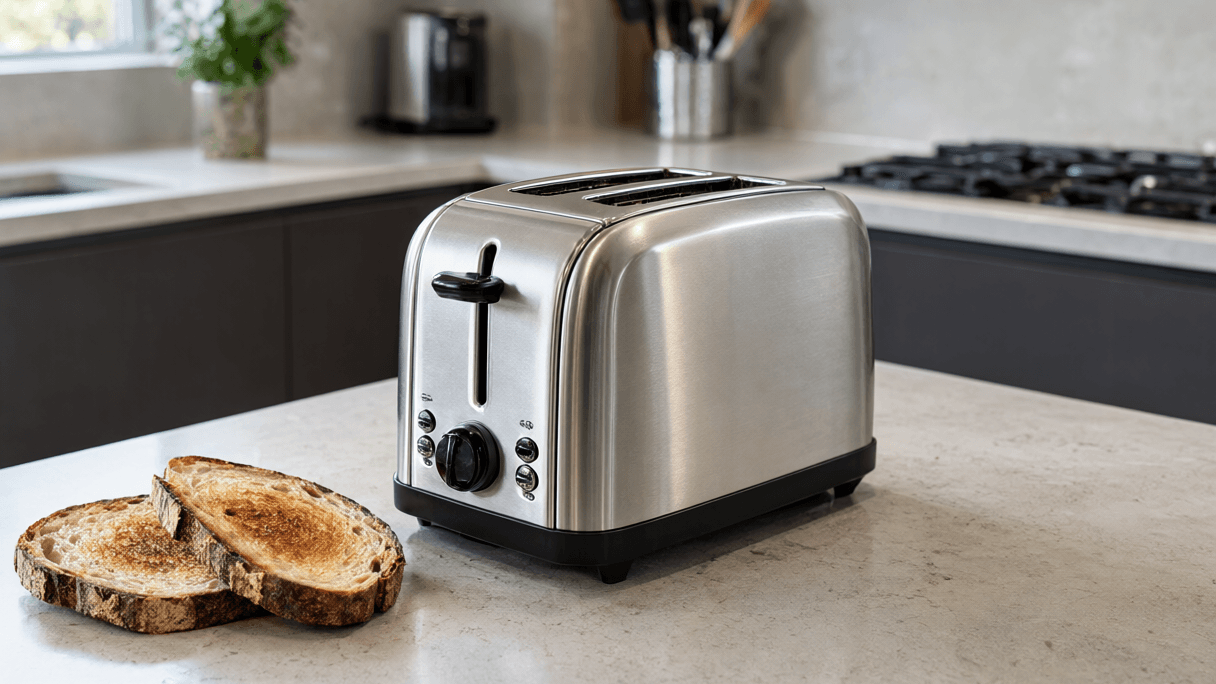
AI-generated image · US National Wire
Opinion: Optical sensors are a fancy party trick that can't mask the fact that this toaster still can't actually brown a slice of sourdough evenly.
I have a rule when it comes to gadgets: I don't trust the spec sheet. I trust the toast. And after diving into the Breville Eye Q, as Wired first reported, it is clear that Breville is betting on a high-tech distraction to justify a price tag that is, frankly, absurd.
Let's get the fireworks out of the way. According to reporting from Wired, the Eye Q ditches the traditional timer for optical sensors that scan your bread 10 times a second. If you use this thing in the dark, you'll see laser-green lights blinking in the slots like a miniature disco. It's a cool party trick, and as Wired notes, it is impressive that Breville figured out how to make a toaster cook this way. But here is the problem: I don't eat laser lights for breakfast. I eat toast.
At $300 for the two-slot model and $400 for the four-slot version, this machine isn't just competing with the toaster in your pantry; it's positioning itself as a premium appliance. But when you pay that kind of money, the results should be superior, not just 'acceptable.' Wired's testing found that the toasting quality is comparable to a regular toaster, not better. Specifically, the toasting is often uneven—the top of the slice tends to be darker than the bottom, and there are noticeable differences from front to back.
Then we have the 'Sourdough mode.' Breville claims this feature prevents the edges of sourdough—which are more prone to burning—from overcooking by stopping the process when the center is slightly lighter. It sounds great on paper. In reality, if the toaster can't even provide a consistent brown across a standard slice of bread, a software-driven 'mode' isn't going to fix the fundamental lack of even heating.
Even the settings are a gamble. Wired conducted a test using seven consecutively darker batches of toast, and the results were erratic: settings two and three were nearly identical, and setting six was somehow lighter than setting four. When a toaster's primary interface—the doneness levels—is that inconsistent, the optical sensors aren't providing precision; they're providing a facade.
To be fair, Breville nailed the aesthetics. The 'dark noir' brushed steel looks sharp, and the ceramic-coated top is a smart move for longevity. I also appreciate the practical touches mentioned by Wired, like the easy-to-use crumb tray and the looped power cord that saves on wear and tear. But these are design wins, not culinary ones.
Bottom line: The Breville Eye Q is a triumph of engineering over utility. It's a beautiful machine that can tell you exactly when your toast is done, but it can't actually ensure that the toast is done evenly. Until the sensors can fix the uneven browning, this is just a very expensive way to make mediocre toast.