
The Battery Factory Gamble: Can Ambrosia Actually Scale to Save the AI Boom?

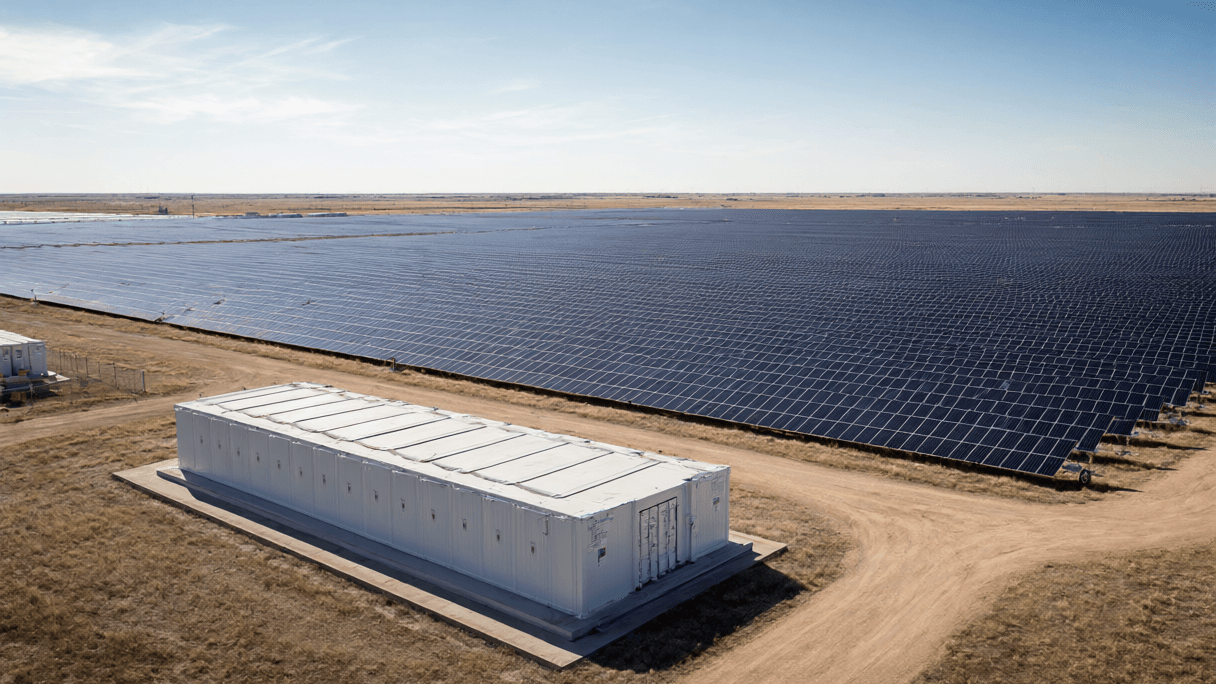
AI-generated image · US National Wire
Opinion: While Ben Longmier's vision for a 10 GWh factory is ambitious, the real test isn't the venture capital hype—it's whether these off-grid power plants can truly replace natural gas turbines.
In the race to power the AI revolution, the industry is hitting a wall: the power bottleneck. As first reported by TechCrunch, hyperscalers are increasingly turning to natural gas turbines to keep their data centers humming, a move that contradicts the climate goals of the tech giants. Enter Ambrosia Energy. While the venture capital world loves a good origin story—and co-founders Ben Longmier and Sara Spangelo certainly have one, having previously sold their satellite startup, Swarm, to SpaceX—I am less interested in the pedigree and more interested in the deployment.
As reported by TechCrunch, Longmier recently announced at TechCrunch Disrupt that Ambrosia is breaking ground on a 150,000-square-foot battery factory near Austin, Texas. The goal is a 10 gigawatt-hour capacity, which Longmier claims will allow the company to build roughly one 300-megawatt power plant per year at their field sites.
Here is where the pragmatic optimist in me gets curious. The premise is simple: solar plus batteries. Solar panels handle the daytime load and charge the system, while batteries take over at night and during cloudy intervals. To make this viable, Ambrosia is targeting a cost of $100 per megawatt hour. Longmier argues that even with the necessity of "overbuilding" solar and battery capacity to ensure continuous uptime, they can remain profitable at that price point and compete directly with the natural gas turbines currently favored by hyperscalers.
But the gap between a pilot and a planetary-scale solution is vast. TechCrunch notes that Ambrosia’s pilot-scale plant has operated continuously for over 100 days, generating 200 kilowatts of electricity 24/7. That is a far cry from the commercial power plant they plan to launch in West Texas later this year, which aims to pair 300 megawatts of solar with 660 megawatt-hours of batteries to provide 30 megawatts of continuous power at 99.3% uptime.
To hit these aggressive cost targets, Longmier is betting on vertical integration and extreme simplification. He told TechCrunch that by manufacturing battery packs in-house and reducing part counts, Ambrosia has created a pack with the fewest parts by a factor of about 100 compared to competitors. This has reportedly brought their costs down to about 1.3x the cost of the bare cell, whereas most stationary storage systems sit at 5x or 7x.
Whether this is a scalable breakthrough or a localized success remains to be seen. Longmier expects full production at the Texas factory in two to three years. In the world of AI data centers, where power needs are exploding overnight, three years is an eternity.
If Ambrosia can actually deliver on this capacity and maintain that $100 per megawatt hour price point, they won't just be another successful startup; they will have solved the single biggest physical constraint on the AI boom. Until then, I'll be watching the factory floor in Austin, not the pitch decks.