
Expensive Necklaces or Actual Tools? Putting AI Wearables to the Test

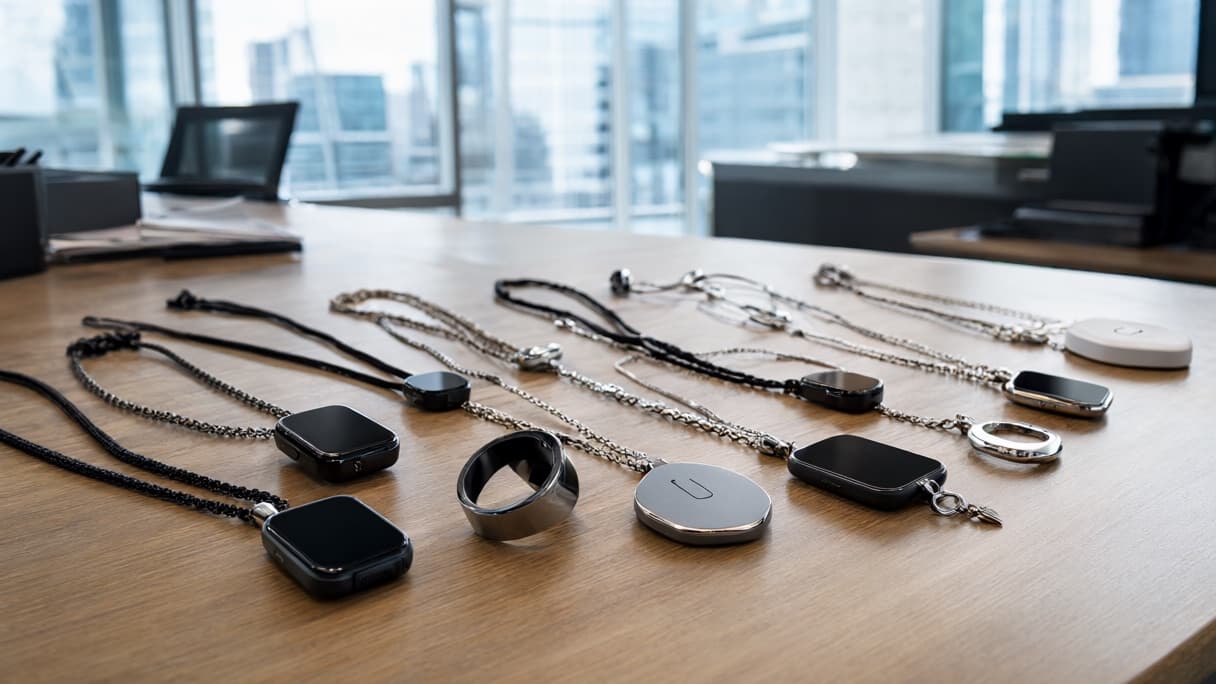
AI-generated image · US National Wire
From $50 pendants to $249 growth trackers, the market is flooded with AI gadgets. I'm looking past the spec sheets to see if these devices actually solve problems.
I've spent enough time with spec sheets to know they rarely tell the whole story. Right now, the consumer tech market is being flooded with 'AI wearables'—a chaotic mix of rings, wristbands, and pendants. Some claim to be productivity powerhouses, while others want to be your best friend. But as I put these through a real-world stress test, the central question remains: are these actually useful tools, or just expensive necklaces with a chatbot attached?
On the productivity side, we have the transcription-heavy devices, as TechCrunch first reported. Plaud offers the NotePin for $159, targeting students, lawyers, and journalists with real-time recording and AI summarization. While it includes 300 free monthly minutes, a Pro plan at $8.33 per month bumps that to 1,200 minutes. Plaud is also prepping a $179 ultra-thin model called the Plaud Note Pro. Then there is Limitless (formerly Rewind), a $99 pendant that turns meetings and calls into searchable knowledge. It provides 10 hours of AI features monthly, with an unlimited tier for $29 per month.
Amazon has entered the fray by acquiring a startup to launch the Bee line. TechCrunch reports that the Bee pendant starts at $49.99, requiring a $19 monthly subscription for its iOS app. Amazon has expanded this with the Bee Frontier ($74.99) and the Bee Eclipse ($99.99), the latter being a credit-card-sized device that sticks to a smartphone. These devices record audio to create notes and reminders, and users can integrate them with Alexa.
Then there are the 'companion' devices, which feel more like social experiments than tools. Friend is a $129 white pendant designed for emotional support. It listens constantly to recognize mood and tone, though it has faced public backlash in NYC, where subway ads were vandalized with messages citing "surveillance capitalism." In response, the company launched "Friend 2.0," adding a built-in speaker for a more distinct personality. Similarly, Omi ($89) uses ChatGPT to remember user context and offer personalized advice. In a bizarre design choice, Omi can be attached to the side of a user's head using medical tape.
For those looking for something more niche, Nirva is positioning itself as a personal growth tool rather than a productivity aid. Founded by former Meta Reality Labs employees, Nirva's $249 pendant or bracelet turns speech into a personal journal to help users analyze their habits and emotions. Orders open in November, with shipments expected by year-end.
Beyond the pendants, we have handhelds and upcoming releases. The Rabbit R1 is a $199 retro-styled device with a rotating camera and touchscreen designed to handle tasks like ordering meals or booking flights. Meanwhile, Meta debuted its first AI-powered wearable this past September. This pocket-sized device, which features a miniature display and a playful avatar named Jolly, allows users to access the Muse AI assistant via voice commands.
**Opinion:** When you strip away the hype, many of these devices are essentially microphones with a subscription fee. While the professional utility of a Plaud or Limitless is clear for someone who lives in meetings, the 'emotional support' of a Friend or the 'growth journaling' of a Nirva feels like a solution searching for a problem. Until these gadgets can do something my phone can't do in three seconds, they risk becoming high-tech jewelry.