
Your Router Is Watching You: The Invisible Surveillance of Ordinary WiFi

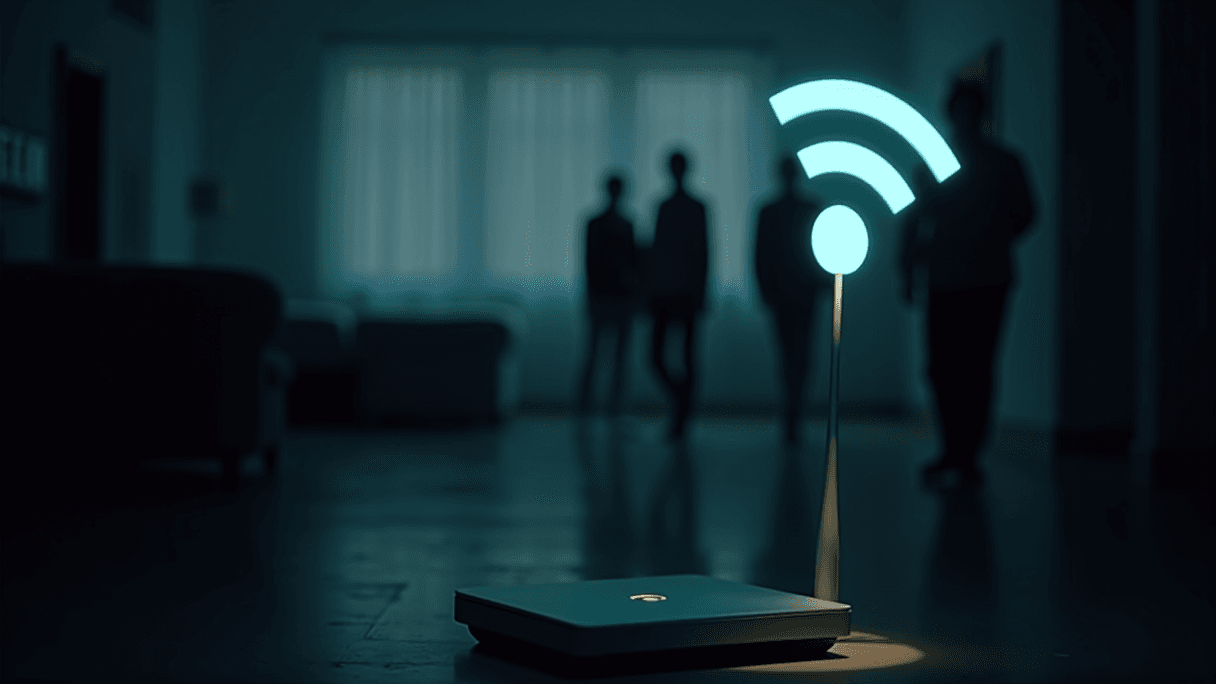
AI-generated image · US National Wire
New research reveals that standard wireless networks can identify people with near-perfect accuracy, turning home and public routers into silent tracking beacons.
For years, we've been told that the privacy of our homes is a sanctuary, provided we lock the doors and keep our devices secure. But as a consumer advocate, I've always warned that the carriers and the hardware they push into our living rooms are rarely acting in our best interests. Now, we have proof that your 'private' home network is effectively a tracking beacon.
As ScienceDaily first reported, researchers at the Karlsruher Institut für Technologie (KIT) have discovered that ordinary WiFi networks can identify and track individuals without the need for cameras, special sensors, or even a connected device in the person's pocket. This isn't about some high-tech spy gadget; it is about the standard wireless local area network (WLAN) infrastructure already embedded in our offices, restaurants, and homes.
***
**OPINION: The Monetization of Movement**
While the researchers focus on the technical feasibility, we need to talk about the incentive. In a world where data brokers and carriers monetize every single movement, the ability to identify a human being via radio waves—without them even owning a phone—is a goldmine. We are moving toward a reality where your physical presence in a room is a data point to be harvested, packaged, and sold, all while you believe you are simply enjoying 'high-speed connectivity.'
***
Professor Thorsten Strufe of KASTEL, KIT's Institute of Information Security and Dependability, explains that by observing the propagation of radio waves, the system can create an image of the surroundings and the people within them. He notes that the process is similar to a normal camera, except it uses radio waves instead of light.
Crucially, this surveillance does not require the target to carry a smartwatch or a phone. Even if you turn off every device you own, you are still visible. As long as other WiFi devices in the vicinity are active, the system can function. In a study involving 197 participants, the KIT system identified individuals with nearly 100% accuracy, regardless of the angle or the person's gait.
How is this possible with off-the-shelf hardware? The researchers found that standard WiFi devices routinely exchange unencrypted signals known as beamforming feedback information (BFI) to optimize wireless communication. Because these signals are unencrypted, anyone within range can read them. By analyzing this BFI, a machine learning model can generate images of people and identify them within seconds.
Julian Todt of KASTEL warns that this turns every router into a potential surveillance tool. He points out that if you regularly pass a café with a WiFi network, you could be identified without your knowledge, potentially by companies or public authorities. While Felix Morsbach notes that intelligence agencies currently have easier access to CCTV or video doorbells, he warns that the omnipresence of wireless networks creates an invisible, suspicion-free surveillance infrastructure.
This is why the researchers are calling for immediate action. They are urging that privacy safeguards be integrated into the upcoming IEEE 802.11bf WiFi standard before these capabilities are exploited at scale. The project, funded under the Helmholtz "Engineering Secure Systems" topic, serves as a stark reminder: the connectivity the carriers sell us often comes with a hidden cost to our fundamental rights.