
The Wireless GPU Paradox: Why the WiCi One is a Solution in Search of a Problem

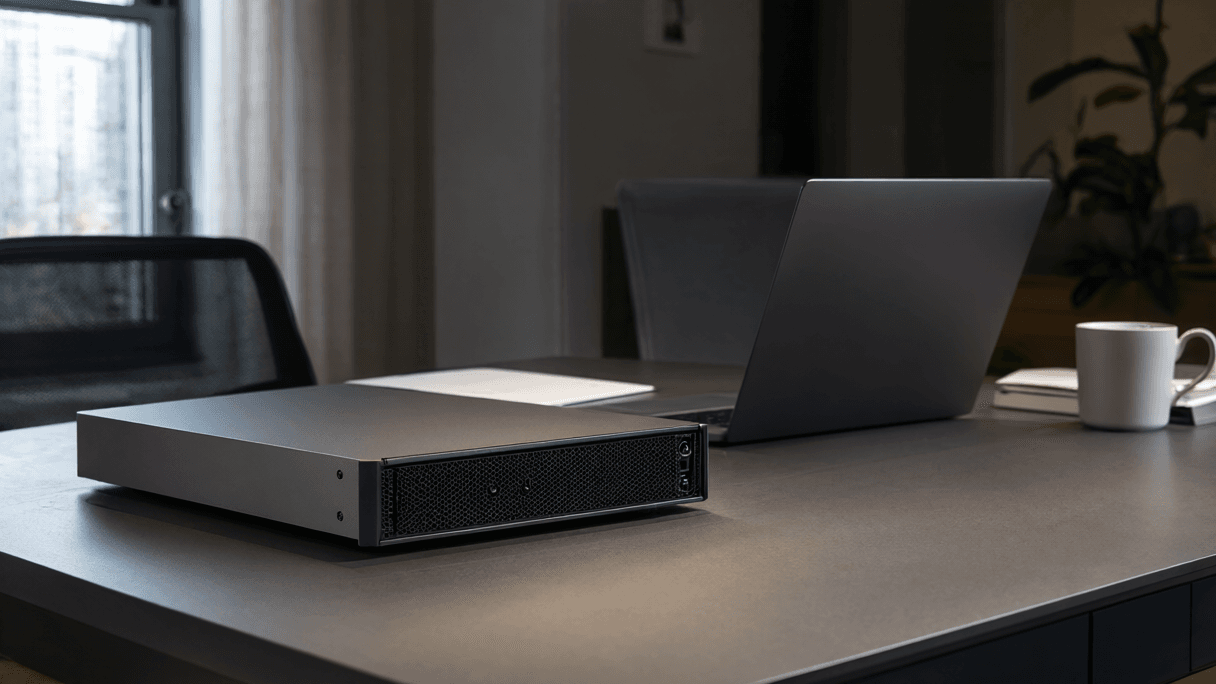
AI-generated image · US National Wire
WiCi promises a cable-free gaming revolution with its $1,999 external GPU, but trading physical connections for Wi-Fi 7 may render its high-end performance moot.
**OPINION:** In the world of high-performance computing, the cable is not the enemy; latency is.
As Engadget first reported, WiCi is betting that consumers are tired of the tether with the introduction of the WiCi One. This external GPU (eGPU) aims to provide high-end graphics power to slim laptops via Wi-Fi 7, ditching the Thunderbolt or OCuLink cables typical of its competitors to transform devices into gaming rigs or AI powerhouses.
The hardware is formidable on paper. According to Engadget, the base model includes 1TB of NVMe storage, an Intel Core 3 100U CPU, and an Nvidia RTX 5060 Ti 16GB GPU. A higher-tier version is also planned, featuring an Intel Core Ultra 7 225H, an Nvidia RTX 5090 32GB, and a 4TB NVMe 5 SSD.
WiCi claims the RTX 5060 Ti model can handle *Cyberpunk 2077* at 80 fps (4K Ultra with DLSS 4) and *Black Myth: Wukong* at 60 fps (4K Cinematic with DLSS 4). However, routing that raw throughput over a wireless module—even Wi-Fi 7—introduces a bottleneck that contradicts the hardware's purpose.
With preorders for the base model starting at $1,999 and eventually rising to $2,599, consumers are paying a premium for a "wireless" gimmick that introduces volatility into a high-cost equation. The WiCi One isn't solving a problem; it's creating a performance gap and calling it a feature.