
The Cognitive Rot of the Feed: Why Doomscrolling is Killing the Ability to Build

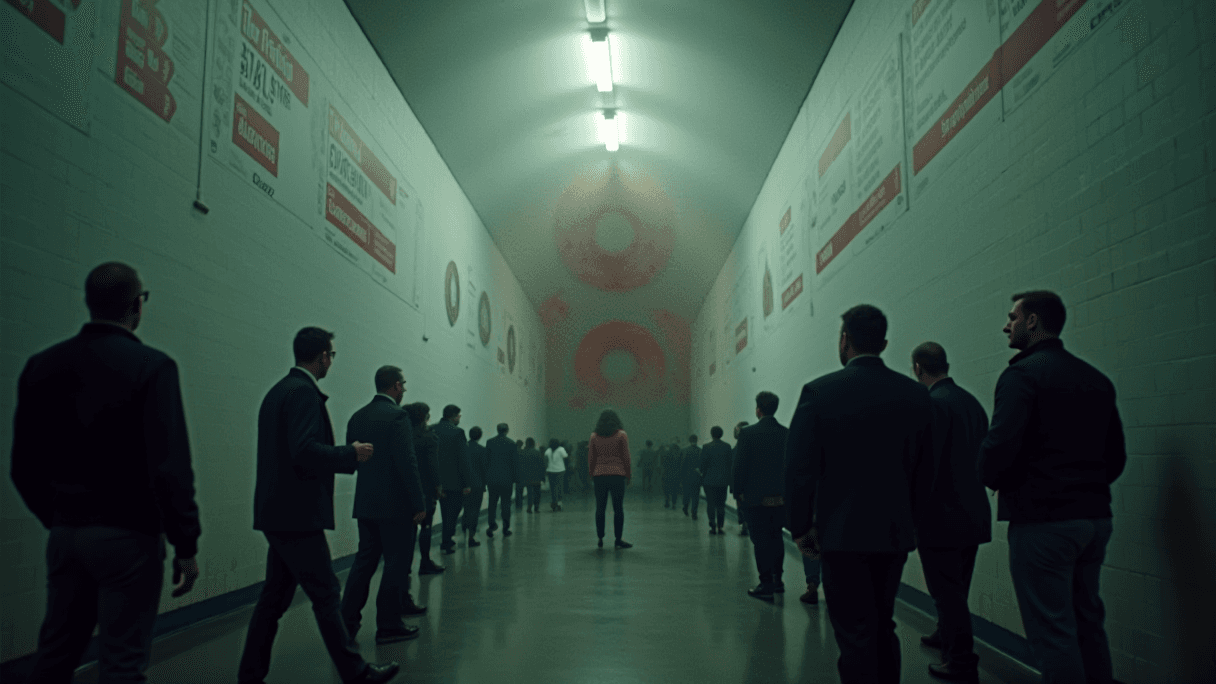
AI-generated image · US National Wire
Opinion: We treat doomscrolling as a productivity leak, but the real danger is a fragmented mind incapable of the deep engagement required to create lasting tech.
I have spent enough time in the trenches of Web3 to know that the industry is obsessed with 'productivity hacks.' We treat the human brain like a piece of hardware that can be optimized with the right Pomodoro timer or a specific brand of mechanical keyboard. But as I look at the next generation of developers, I see a crisis that no time-management app can fix.
We are witnessing the systematic fragmentation of the developer's mind. As Texas A&M University first reported, the corporate world has largely viewed 'doomscrolling'—the obsessive consumption of negative or distressing information on social media—as a simple matter of lost minutes. Management sees a worker staring at a screen and calculates the lost billable hours. They think the problem is the time spent looking at the glass.
They are wrong. The real cost isn't the time; it's the cognitive residue.
Research led by Dr. Ian Hughes, an assistant professor in the Department of Psychological and Brain Sciences at Texas A&M University, suggests that the damage persists long after the phone is put away. Analyzing workers across the United States and the United Kingdom, Hughes and his team observed that those who doomscroll during the workday are more prone to ruminating on the distressing content they consume. This isn't just a momentary distraction; it is a lingering mental preoccupation.
As Dr. Hughes explains to Texas A&M University, workers become less engaged because their minds are effectively replaying the distressing images and messages encountered during their scrolling sessions.
In the world of software engineering and protocol design, 'engagement' isn't just a corporate buzzword. It is the prerequisite for deep work. To build something that lasts—something that isn't just another fork of a failing project or a superficial dApp—you need the ability to hold complex, interlocking systems in your head for hours on end. You need a level of cognitive cohesion that is fundamentally incompatible with a mind that is constantly 'replaying' the latest geopolitical catastrophe or social media firestorm.
When your brain is stuck in a loop of rumination, you aren't just losing twenty minutes of coding time; you are losing the ability to enter a flow state. You are trading architectural brilliance for a fragmented series of interruptions. If the next generation of devs cannot maintain a singular focus because they are perpetually soothing their anxiety through a feed, we aren't just losing productivity—we are losing the capacity for innovation.
Dr. Hughes notes that this behavior is particularly prevalent among people aged 18 to 35, the exact demographic currently tasked with building the future of the internet. He describes doomscrolling as a 'double-edged sword,' noting that it is essentially an information-seeking behavior. People aren't scrolling because they enjoy the distress; they are trying to make sense of uncertainty, whether it be a pandemic, a war, or a public safety threat.
This is the trap. The attempt to find certainty in a chaotic world leads to a cycle of exposure to negative content that is nearly impossible to shake. For those with higher levels of neuroticism—a trait associated with worry and anxiety—the link between doomscrolling and lower work engagement is even stronger, according to the research published in *Computers in Human Behavior*.
We are now in an era where the workplace is uniquely vulnerable because the news cycle is portable. As Dr. Hughes told Texas A&M University, the world of work is one of the few places where people don't leave their cellphones at home. The feed is always there, tucked into the gaps between meetings and emails, waiting to fragment your attention once more.
Some might argue for strict bans on phones in the office, but Dr. Hughes warns that such policies often fail and simply make employees upset. Instead, he suggests a spatial boundary: containing the behavior to one physical location, such as a coffee shop, a bar, or a comfortable chair at home.
While setting boundaries is a start, I suspect the problem is deeper. We are fighting against algorithms specifically designed to feed us attention-grabbing content. As Dr. Hughes admits, this behavior is here to stay because social media access is expanding and the algorithms are relentless.
If we continue to treat this as a 'time management' issue, we will fail. The real crisis is that we are training a generation of builders to be perpetually distracted, their minds cluttered with the debris of a thousand negative headlines. You cannot build a cathedral of code if you can only focus for ten minutes before the urge to 'stay informed' pulls you back into the void.
Staying informed is a necessity, but as Dr. Hughes rightly points out, that information-seeking cannot occupy every moment of our lives. If it does, the only thing the next generation will be capable of building is a faster way to scroll through the ruins.