
The $30 Billion Signal: Space Force Pivots to Industrial-Scale Launch

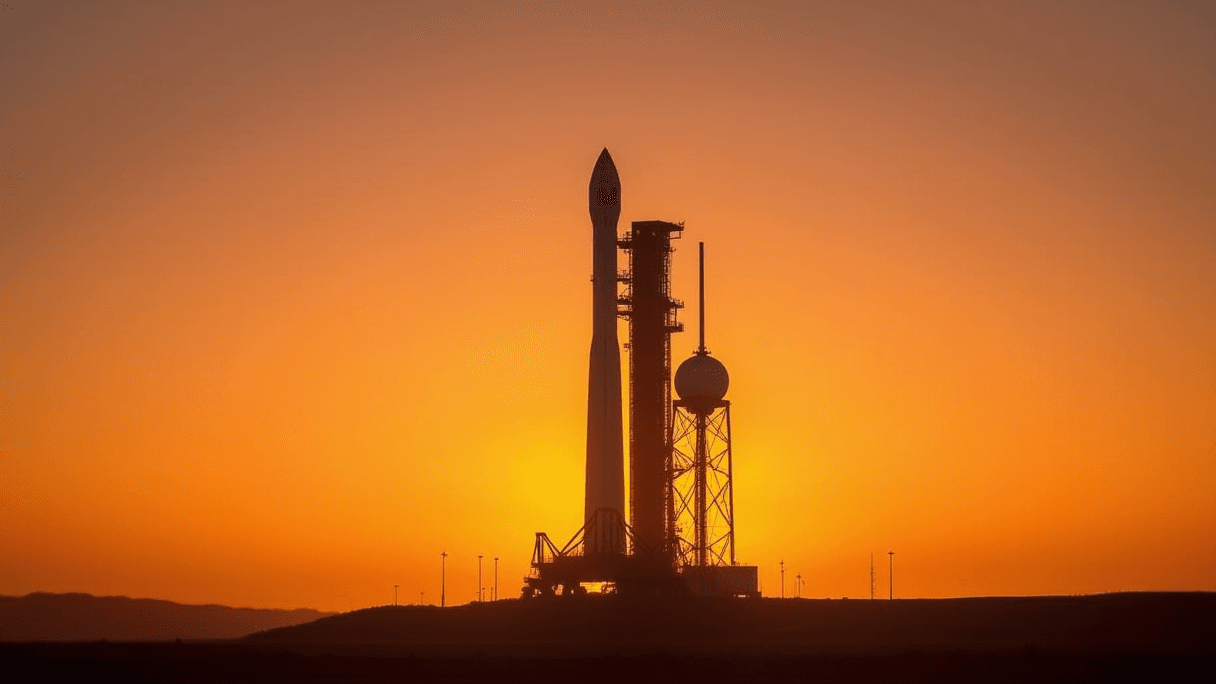
AI-generated image · US National Wire
By tripling the ceiling on Lane 1 procurement, the Pentagon is moving beyond experimental prototypes toward a high-cadence architecture to support massive new constellations and the 'Golden Dome' shield.
In the world of defense procurement, the most honest signal isn't found in a press release or a strategic white paper—it is found in the ceiling of a contract.
On Friday, the U.S. Space Force sent a massive signal. Military officials announced they are tripling the maximum value of the National Security Space Launch (NSSL) Phase 3 Lane 1 contract, raising the cap to $17 billion, as Ars Technica first reported. When combined with the $13.7 billion ceiling set last year for Lane 2, the total procurement window for these two lanes now exceeds $30 billion.
To understand why this shift matters, you have to look at the mechanism of the NSSL program. Managed by Space Systems Command, the program splits launches into two distinct risk profiles. Lane 2 is the fortress: it is reserved for high-priority strategic missions, such as radiation-hardened communications satellites designed to survive nuclear conflict or the government's most expensive spy satellites. Because of the stakes, Lane 2 requires exhaustive military certification. As of now, only three rockets have cleared that hurdle: SpaceX’s Falcon 9 and Falcon Heavy, and United Launch Alliance’s (ULA) Vulcan.
Lane 1, however, is where the Space Force is now placing its biggest bets. This lane is designed for risk-tolerant missions, including medium-lift launches with experimental payloads and rideshare missions for data relay or surveillance constellations. Crucially, Lane 1 is open to commercial providers without the extensive certification process required for Lane 2.
Originally, the Space Force viewed Lane 1 as a relatively modest operation. Ars Technica reports that officials initially estimated a need for at least 30 task orders over five years, capping the contract at $5.6 billion. The jump to $17 billion suggests that the military's appetite for orbital access has evolved from a series of experiments into a requirement for industrial-scale cadence.
***
**OPINION: The Shift to High-Cadence Architecture**
In my view, this isn't just a budget adjustment; it's a fundamental pivot in how the U.S. views space superiority. For years, the narrative was about 'prototyping' and 'testing.' But you don't triple a procurement ceiling unless you are moving toward a production-line mentality. By aggressively funding Lane 1, the Space Force is building a diversified, high-volume launch architecture that can sustain the rapid deployment of constellations rather than the slow, precious delivery of single, massive satellites.
***
Follow the money, and you see exactly which programs are driving this urgency. The Space Force has already awarded multibillion-dollar contracts to SpaceX for the deployment of satellites for the Airborne Moving Target Indicator (AMTI) and Space Data Network (SDN) programs, both of which are intended to provide targeting information and global connectivity for U.S. forces.
Then there is the 'Golden Dome.' This proposed missile defense shield from the Trump administration is expected to require an unspecified number of space-based interceptors and missile warning sensors. A project of that scale cannot be launched on a handful of bespoke rockets; it requires a conveyor belt to orbit.
This shift is reflected in the broader budgetary requests. The Trump administration asked for $71.1 billion for the Space Force in fiscal year 2027, nearly double the roughly $40 billion earmarked for fiscal year 2026, according to Ars Technica. While the House Appropriations Committee’s draft 2027 budget is more conservative, proposing $55.5 billion, the trajectory is clear: the Space Force is scaling up.
As for who will actually get the checks, the field is widening. While SpaceX has won the majority of Lane 1 task orders to date and Blue Origin secured its first win earlier this year, the roster of competitors is growing. In addition to SpaceX, ULA, and Blue Origin, the Space Force has added Rocket Lab, Stoke Space, Relativity Space, and Impulse Space to the pool of companies competing for Lane 1 fixed-price task orders.
Space Systems Command has not yet disclosed the exact number of additional missions it intends to order beyond the initial 30-mission estimate for Lane 1. However, the Lane 2 requirements are already ballooning. Just one year after projecting 54 launches through 2029, Space Systems Command announced in April that it had identified 25 additional Lane 2 missions.
When you combine the surge in Lane 2 strategic needs with the massive $17 billion expansion of Lane 1, the message is clear: the Space Force is no longer just exploring what is possible in orbit. It is building the industrial capacity to dominate it.