
Beaming Power to the Clouds While Ground Connectivity Withers

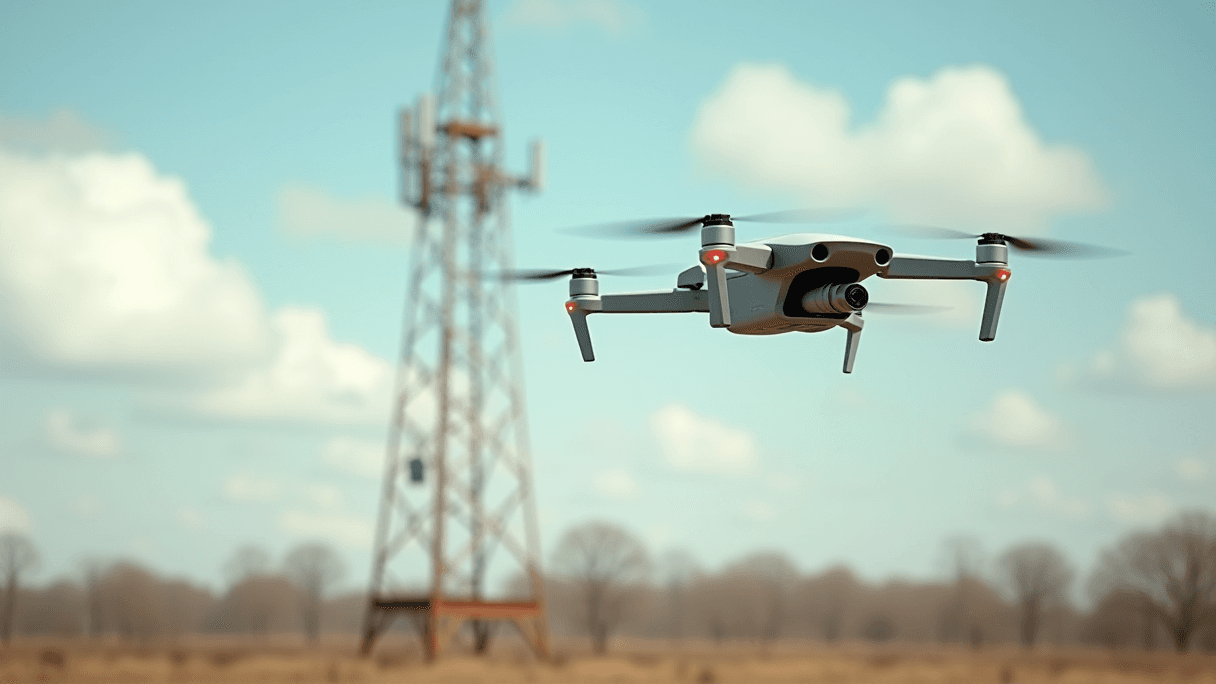
AI-generated image · US National Wire
The UK is sinking £70 million into high-altitude 'pseudo-satellites,' but for the average consumer, these stratospheric fantasies do nothing to fix the terrestrial failure of the carriers.
OPINION: There is a particular kind of irony in the UK government's latest obsession with the stratosphere. While millions of us are still fighting for a stable signal in our own living rooms, the state is betting big on the idea that the answer to connectivity is to beam power from the ground to aircraft floating 12 miles in the air.
As first reported by The Register, the Advanced Research and Invention Agency (ARIA)—a body sponsored by the Department for Business, Innovation, Science and Trade (BIST)—is pouring £70 million into a program called Enduring Atmospheric Platforms. The goal is to develop high-altitude pseudo-satellites (HAPS) that can act as alternatives to orbital satellites for underserved areas.
On paper, it sounds like a sci-fi fever dream. ARIA is backing 18 projects over three and a half years to see if an aircraft can maintain a communications payload of 300 W for a full week. We are talking about a range of technologies that sound more suited to a comic book than a utility rollout. Scalable Laser Ltd is working on laser-based power beaming, while Space Solar Engineering Ltd is pursuing radio frequency power beaming. Then there is the University of Bath, which is developing 'STRAT-NAV' to help aircraft ride atmospheric gravity waves created by hills and weather fronts.
Even the aircraft designs are wildly speculative. The Register notes that ARIA's program director, Rico Chandra, is backing everything from fixed-wing solar aircraft to designs featuring spinning wings. We have aerospace startup Menapia proposing a 'Carousel' constellation of multi-rotor aircraft to create a persistent 'canopy' over the UK, and VFP Aerospace aiming for a relay system of drones with a target production cost of £50,000 per unit. Meanwhile, Hypanode Ltd is attempting to build fuel cell systems that offer 20 times the energy of current batteries.
Here is the problem: the 'underserved' communities ARIA mentions aren't suffering because we lack laser-powered drones in the stratosphere. They are suffering because the terrestrial carriers—the companies we actually pay every month—have failed to provide basic, reliable ground-level infrastructure.
It is a classic case of chasing the 'bold idea' while ignoring the boring, essential work of maintenance and deployment. ARIA, which was notably spared from government spending cuts last year and was recently chaired by Matt Clifford, is operating in a world of theoretical endurance and 'cutting-edge research.' But for the consumer, the only 'endurance' that matters is whether the broadband actually works when you need to make a living from home.
Investing £70 million into the hope that we can beam power to a drone to fix a connectivity gap is a distraction. Until the carriers stop treating basic reliability as an afterthought, these high-flying fantasies are just expensive ways to avoid fixing the pipes in the ground.