
The Voltage Glitch Delusion: Hardware Hacks Won't Save the Mining Dream

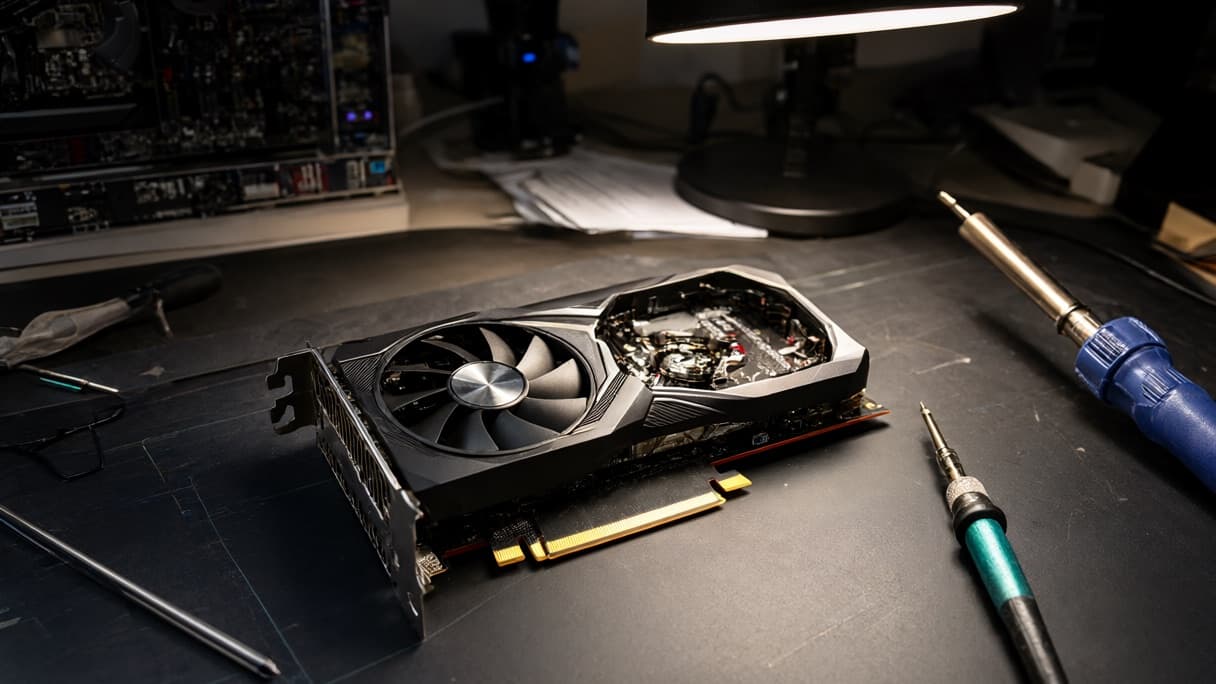
AI-generated image · US National Wire
Opinion: A recent 'breakthrough' converting CMP 170HX cards into A100s via voltage fault injection is less of a victory and more of a desperate gamble by the hardware-obsessed.
Let’s be clear: the era of easy money in crypto mining didn't just end; it collapsed into a heap of overpriced silicon and broken promises. Now, we've entered the 'desperation phase.' This is the stage where the battle-scarred remnants of the mining boom stop looking for new opportunities and start trying to perform open-heart surgery on their existing hardware to squeeze a few more TFLOPs out of a dead horse.
Case in point: as first reported by Hacker News, an unnamed researcher published a technical deep-dive claiming to have discovered a voltage fault injection (VFI) vulnerability on the NVIDIA GA100 die. The goal? Converting a CMP 170HX 8GB card—a piece of hardware designed for the restrictive mining market—into what the author describes as an 'A100-80G.'
On paper, the 'achievement' is impressive. By utilizing voltage glitching to blow arbitrary fuses, the researcher claims to have unlocked the framebuffer, compute capabilities, and features that NVIDIA intentionally disabled on the CMP cards, including PCIe Gen4 and NVLink. They claim their unlocked cards provide roughly 1.2x the performance of a retail A100. According to the Hacker News post, while a retail A100 is yield-safe at 108 Streaming Multiprocessors (SMs), the unlocked CMP 170HX can enable between 120 and 126 SMs, depending on the 'die-lottery.'
Specifically, the author reports an FP16 FMA throughput of 85.858 TFLOP/s on the unlocked hardware, compared to 72.488 TFLOP/s for the retail A100. They also claim to have unlocked features like NVJPG, NVDEC, and MIG, though they admit they haven't specifically tested all of them.
But let's step back from the benchmarks and look at the reality. This isn't a scalable business model; it's a high-stakes hardware hack for the delusional.
NVIDIA uses eFuses for product segmentation and yield control, turning undifferentiated GA100 dies into specific SKUs based on manufacturer demand and defect testing. The researcher's 'breakthrough' relies on the fact that NVIDIA’s design allows restrictions to be relaxed by blowing more fuses—a security flaw that the author notes was disclosed to NVIDIA’s product security team.
To the average observer, this looks like 'free' performance. To anyone who has survived a crypto winter, it looks like a recipe for a fire. Voltage fault injection is not a 'setting' you toggle in a BIOS; it is a dangerous process of manipulating power to force a chip into an unintended state. The author refers to this as 'Goldilock’s glitch' and 'floorsweeping,' terms that sound more like a chaotic science experiment than a sustainable infrastructure strategy.
We are seeing a recurring pattern in the web3 space: when the economics fail, the community pivots to technical obsession. First, it was optimizing rigs; then it was searching for the most efficient ASIC; now, it is literally glitching the voltage of enterprise-grade GPUs to bypass manufacturer locks. It is a desperate attempt to squeeze blood from a stone.
Who is this for? Certainly not the institutional investor or the serious AI researcher. This is for the hobbyist who is too emotionally invested in their hardware to admit that the CMP 170HX is a legacy liability. The idea that you can 'win the die-lottery' by risking the permanent destruction of your GPU via voltage glitching is the ultimate expression of the mining mindset: high risk, low probability of sustainable reward, and a total disregard for the safety of the equipment.
While the researcher acknowledges the work of others, such as Jon Pry, in understanding the GA100 die, the practical application of this knowledge is a dead end. Converting a mining card into a pseudo-A100 doesn't change the fundamental reality that the market for this hardware has shifted. The 'mining dream' is now just a series of expensive, dangerous hardware hacks performed in basements by people who refuse to let go.
If your path to profitability requires you to 'blow arbitrary fuses' and hope your GPU doesn't fry, you aren't running a business—you're running a gamble. The GA100 might have a vulnerability, but the real vulnerability is the belief that a hardware glitch can replace a viable economic model.