
The New Hardware Bottleneck Isn't Silicon—It's Soil

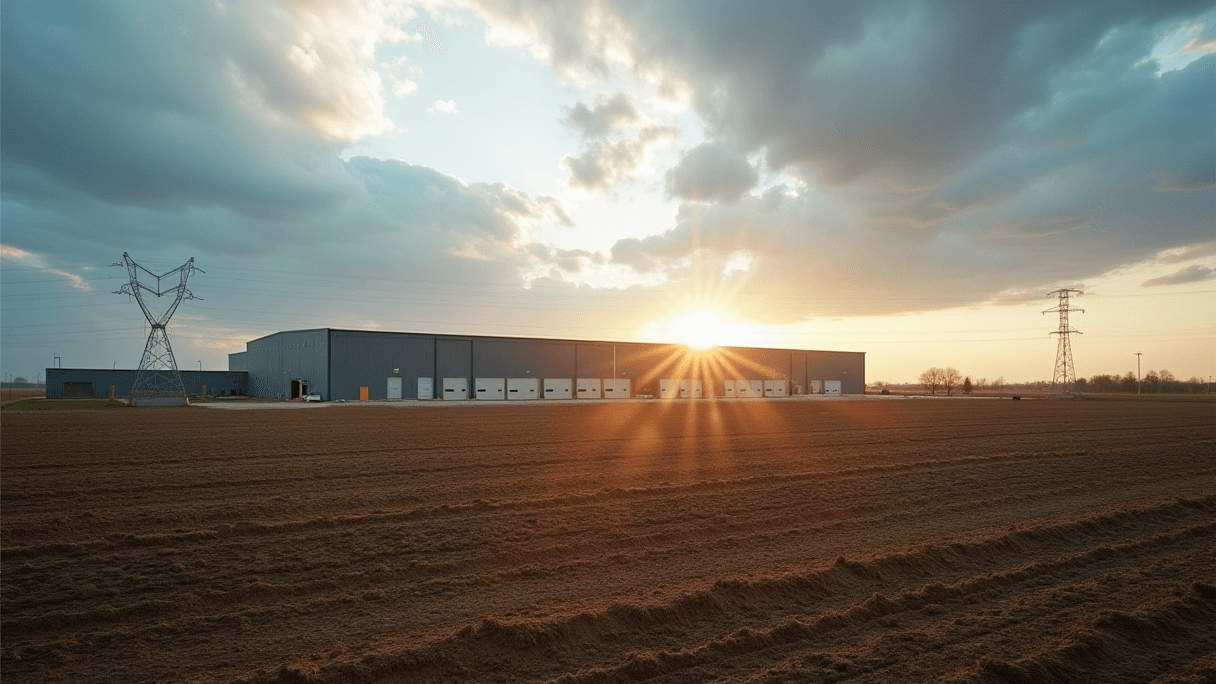
AI-generated image · US National Wire
Opinion: As the Trump administration clashes with its own base over data center expansion, the real threat to AI dominance is no longer a GPU shortage, but a populist revolt against land use.
For the last few years, the narrative surrounding the AI arms race has been defined by a scarcity of silicon. The industry obsessed over H100s and the capacity of fabrication plants. But as we move into this next phase of infrastructure build-out, it is becoming clear that the most restrictive bottleneck isn't the chip—it's the dirt.
We are witnessing a collision between the high-altitude ambitions of tech accelerationists and the grounded, populist anxieties of the American electorate. This is no longer just a technical challenge of power grids and cooling systems; it is a political war over land use, and if the current friction continues, it will make the GPU shortages of the early 2020s look like a minor inconvenience.
As first reported by Wired, the tension has reached the highest levels of the GOP. President Donald Trump has doubled down on his support for AI and data centers, framing the issue as a matter of national security. According to Wired's Hugo Lowell, the president is operating under the belief that restricting data center development is equivalent to restricting compute, which in turn would mean the United States loses the technological race to China. This geopolitical urgency is echoed by White House allies and tech accelerationists like investor and Palantir cofounder Joe Lonsdale and former White House AI czar David Sacks.
However, the president is finding that his own base is running in the opposite direction. The friction is not coming from the left, but from a populist, conservative impulse that views these massive industrial complexes with deep suspicion. Molly McCann Sanders, president of the Eagle Forum Education & Legal Defense Fund, describes herself as a "crunchy MAHA mom" who is alarmed by the potential for data centers to pollute and is fiercely opposed to the use of eminent domain. To Sanders and those like her, the push for rapid expansion is a misstep, particularly as the GOP attempts to court a "laptop class" of tech-enthusiastic young men.
This isn't just a fringe sentiment. Data from a poll released by The New York Times shows that over 60 percent of the American public—including 47 percent of Republicans—are opposed to building new data centers. The internal alarm within the party is palpable. Wired reports that the National Republican Senatorial Committee sent a private memo to AI companies warning that party committees cannot fix the "toxic brand" of this specific economic segment. Similarly, GOP strategist Tony Fabrizio issued a memo to candidates stating that "unqualified support" for these centers is a losing political position.
President Trump has attempted to shame this opposition, writing on Truth Social in late August that only communities wanting to be "backwards and poor" would reject data centers. But the backlash is immediate and visceral. An analysis by The New York Times of thousands of responses on Truth Social found that anti-AI and anti-data-center comments from MAGA accounts outnumbered positive ones by four to one.
From a business and gaming perspective, this is a critical inflection point. The "interactive" future—generative worlds, massive LLM-driven NPCs, and seamless cloud compute—requires physical space. The scale of this ambition is staggering. According to The Washington Sun, the Interior Department is reviewing at least 12 proposals for data centers that would cover no less than 17,600 acres of public land, a significantly higher number than previous reports suggested.
When the physical reality of these centers hits the ground, the "tech" part of the equation disappears and is replaced by "nuisance." This is exemplified by "Bezzy," a server-shaped plushie described by Wired's Boone Ashworth. The toy emits the actual droning noise recorded from people living near a data center in Virginia, serving as a tangible reminder that these facilities are not invisible clouds, but noisy, energy-hungry industrial neighbors.
We are seeing this play out in the electoral trenches. In Wisconsin, Republican gubernatorial nominee Tom Tiffany has received Trump's endorsement but has simultaneously attacked his opponent, David Crowley, for being pro-data center. In Pennsylvania, Natalie Fertig's reporting for Wired highlights the success of anti-data-center organizers in blocking major projects.
If the hardware race is to be won, the industry cannot simply buy its way out of this problem with more capital. You cannot "disrupt" a community's hatred of eminent domain or their fear of pollution. The accelerationists believe that the China competition angle will eventually force the hand of the electorate, but the current data suggests a profound disconnect.
Trump may believe that MAGA will ultimately back him on AI, just as they have on other contentious issues, but the land-use battle is different. It is local, it is physical, and it is emotional. If the industry continues to treat the American landscape as a blank map for compute clusters, they will find that the most powerful GPU in the world is useless if you can't find a single acre of land where people will actually let you plug it in.