
The Hardware of History: What a Retreating Ice Cap Tells Us About Climate Scale

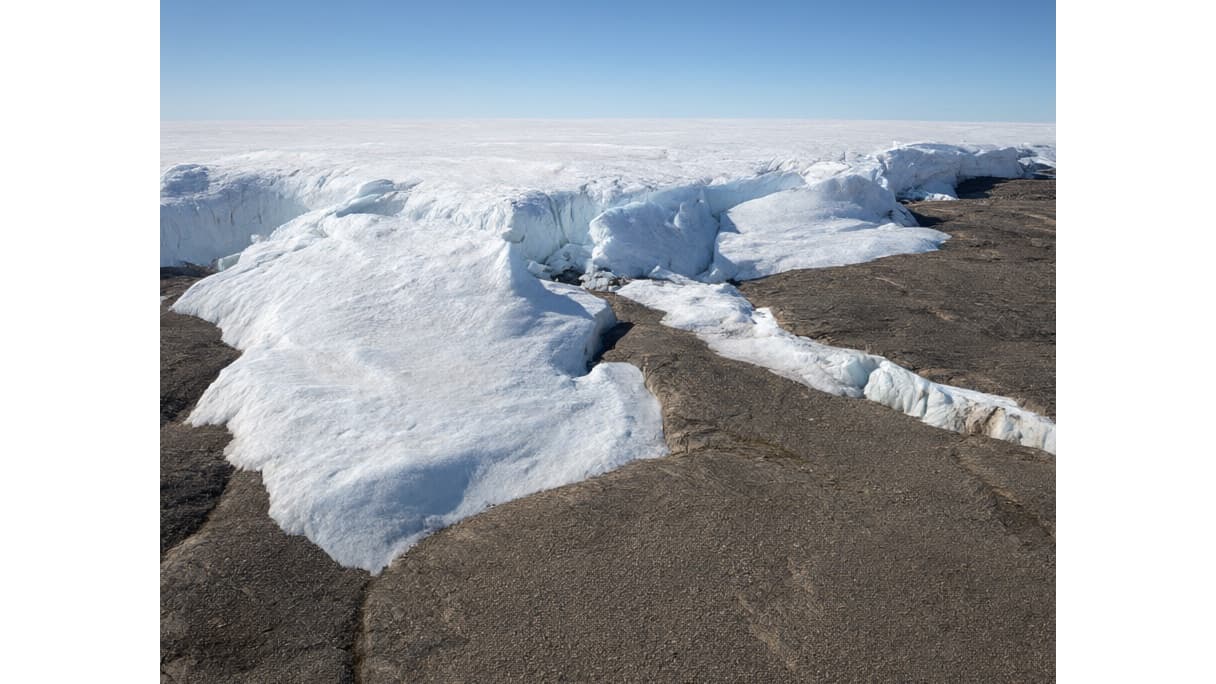
AI-generated image · US National Wire
If human emissions were powerful enough to derail a pending glacial epoch, the mechanical capacity to reverse our current trajectory exists—if we prioritize deployment over discourse.
The scale of human impact on the planet is often discussed in abstract percentages or future projections. However, recent research published in the journal *Science* provides a concrete, historical benchmark for just how much leverage we actually possess over the Earth's systems.
According to reporting from *Wired*, as the outlet first reported, a study led by Nicolás Young, a paleoclimatologist at the Lamont-Doherty Earth Observatory at Columbia University, reveals that the Barnes Ice Cap on Canada's Baffin Island was on a trajectory of growth that may have signaled the start of another glaciation period. By analyzing rock records using Beryllium-10 exposure dating and studying preserved mosses and lichen, Young and his team determined the ice sheet first reached its modern size roughly 3,600 years ago and began growing again approximately 2,000 years ago.
Then, the trajectory shifted. *Wired* reports that starting in the 1960s—coinciding with a ramp-up in carbon pollution—the ice cap reversed course. Since the 1980s, the edges of the Barnes Ice Cap have retreated by an average of four meters per year. As Young notes, this modern retreat has effectively reversed 2,000 years of net expansion.
**Opinion: The Deployment Lesson**
From a clean tech perspective, this is a staggering proof of concept. We are often told that the climate is too vast or too complex to meaningfully pivot through human intervention. Yet, as this research suggests, we have already accidentally deployed a 'technology'—the mass burning of fossil fuels—that was powerful enough to derail a planetary-scale geological event.
If we possess the mechanical capacity to accidentally stop an ice age, we possess the capacity to intentionally stabilize the current climate. The problem isn't a lack of physical possibility; it is a lack of scaled hardware. We have spent too long obsessing over the 'hype' of theoretical solutions and funding rounds while the actual machinery of decarbonization lags behind. The Barnes Ice Cap is a reminder that the Earth responds to massive shifts in atmospheric chemistry. To fix the current crisis, we don't need more hypotheses; we need the industrial-scale deployment of carbon-reduction hardware that matches the sheer force of the emissions we've already unleashed.
This finding also settles a long-standing historical debate. Young points out that in the early 1970s, scientists met at Brown University and concluded a glaciation period was so imminent they warned President Richard Nixon. While climate deniers have historically used that warning to claim global warming is a hoax, Young argues this study validates that the scientists were correct about the pending glaciation—it was simply overridden by human-caused warming.
As Meredith Kelly, a professor of earth sciences at Dartmouth, notes to *Wired*, the study shows a clear pattern of the ice cap's behavior, though she suggests further comparison with other global sites to fully understand the mechanisms of the pre-warming glaciation period. For those of us focused on the transition to clean tech, the takeaway is clear: the lever exists. Now we just have to pull it.