
The Ergonomic Divide: Why Curved Displays Thrived in Gaming but Failed in the Living Room

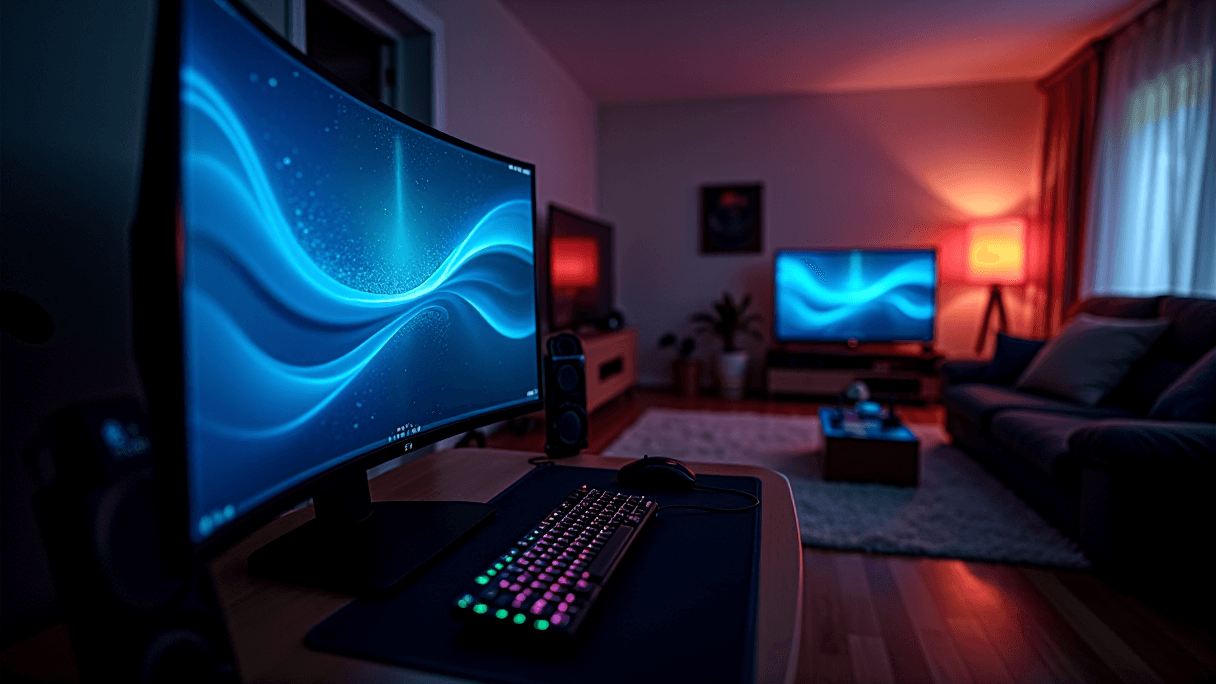
AI-generated image · US National Wire
While curved televisions vanished by 2020, the technology found a permanent home in gaming monitors by prioritizing active immersion over passive viewing.
The trajectory of curved display technology reveals a stark divide between how consumers engage with entertainment in the living room versus the gaming desk. While curved televisions were once marketed as a way to increase immersion, the format effectively died by 2020, as Engadget first reported, with Samsung cited as the final holdout for the technology.
According to reporting from Engadget, the failure of curved TVs was rooted in the physics of the living room. Unlike the massive concave screens found in IMAX theaters or the Cinerama Dome in Hollywood, a 55- to 65-inch curved TV viewed from a distance of six to ten feet failed to replicate a true cinematic sense of immersion. Furthermore, the living room environment—filled with pets, family photos, and decorations—distracted from the experience.
Technical limitations further hampered the TV format. Engadget reports that curved LCDs suffered from a limited "sweet spot" in the center of the viewing angle; viewers sitting off-center experienced a significant loss in color saturation and contrast. Dipin Sehdev, founder and CEO of CE Critic, told Engadget that these sets were also a manufacturing and logistics nightmare. Sehdev noted that maintaining uniformity on 55-, 65-, or 75-inch curved panels was difficult, and the physical protrusion of the screens—sometimes up to 6 inches at the corners—made them unattractive for consumers wanting a clean, wall-mounted look above a mantle.
Conversely, curved gaming monitors have thrived by leaning into the very constraints that killed the curved TV. Because monitors are designed for a single user sitting in close proximity to the screen, the narrow viewing sweet spot is a functional advantage rather than a flaw.
Engadget explains that for gamers, the curve serves a critical ergonomic purpose: it keeps the edges of the screen within the user's direct line of sight, reducing the need to crane the neck. This is especially vital in competitive online shooters, where reaction time to flanking enemies is paramount. This design evolution has enabled the rise of extreme ultrawide displays, such as Samsung's 55-inch Odyssey Ark and Alienware's 34-inch ultrawide. Sehdev told Engadget that these high-curvature screens are particularly sought after by users engaged in simulation gaming, such as Microsoft's Flight Simulator or Gran Turismo.