
The Beauty of the Botch: Why Gaming's 'Messy' Data is the Key to Robotics

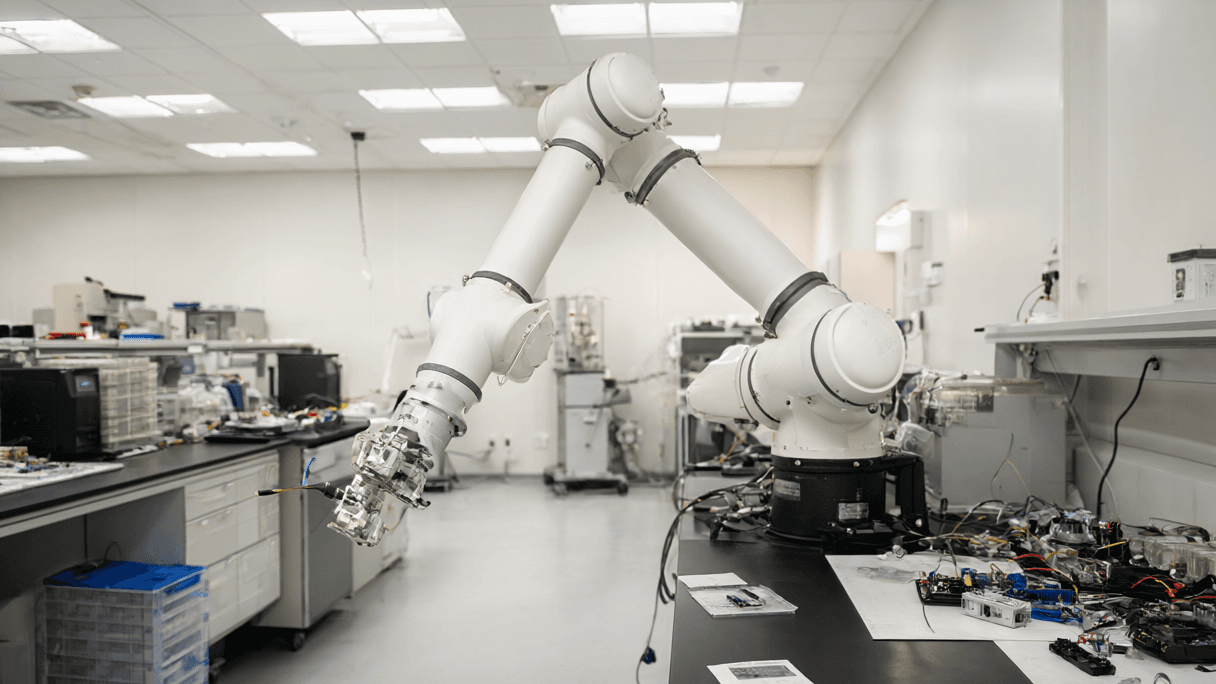
AI-generated image · US National Wire
Opinion: While critics argue video game physics are too coarse for precision, the chaotic, imprecise nature of human play is exactly what world models need to survive the real world.
For years, the gaming industry has viewed player input as a means to an end—a series of thumbstick twirls and trigger squeezes designed to move a character from point A to point B. To the developers, the 'slop' of human input—the imprecise movements and the clumsy errors—is something to be smoothed over by game design. But as we hit a wall with the evolution of artificial intelligence, I argue that this 'waste' is actually the most valuable asset in the room.
We are currently witnessing a pivot in how AI is trained. As Wired first reported, there is a growing consensus in the industry that large language models (LLMs) are fundamentally limited because they lack the ability to navigate the physical world. They can describe a factory floor, but they cannot pilot a robotic arm or steer an autonomous vehicle because they lack the necessary 'cause and consequence' data. To bridge this gap, researchers like Yann LeCun and Fei-Fei Li are pivoting toward 'world models'—AI designed to understand real-world physics through a combination of visual and action data.
Here is the problem: unlike the oceans of text used to train LLMs, there is no massive, ready-made corpus of physical interaction data. Xiatian Zhu, an associate professor at the University of Surrey, notes that the internet provides very little of this specific type of data. While some labs have tried to manually generate data by attaching sensors to humans and robots, Nicole Fraenkel, a partner at Khosla Ventures, points out that this approach is too limited. Repetition in a controlled environment cannot capture the 'disorder of the world.'
This is where the 'dodgy' skills of gamers come in. Worldmodeldata, a British startup advised by Yann LeCun, is betting that the exhaust product of video games—the massive quantities of controller inputs paired with 3D visual data—is the solution. CEO Rhea Loucas tells Wired that the diversity of experiences found in millions of games can be used to teach AI how to operate. Worldmodeldata has already licensed nearly 1 million hours of data from various unnamed studios to fuel this effort.
Critics, most notably those at Nvidia, argue that this is a flawed premise. Ming-Yu Liu, who leads world model development at Nvidia, suggests that video game physics are too 'eccentric' and 'coarse' for tasks requiring fine-grained motor control. He argues that because developers take shortcuts—such as a character picking up an apple without the game simulating the specific pressure of each finger—this data is better suited for generating 3D environments than for precise robotic manipulation. Professor Zhu echoes this, calling game physics 'approximate.'
However, I believe this critique misses the forest for the trees. The value of gaming data isn't in its precision; it's in its imperfection.
When we talk about the 'cost of error' for a drone, a factory forklift, or an autonomous quadruped, as Fraenkel describes it, we aren't talking about the cost of a missed finger-press on an apple. We are talking about the cost of failing to navigate a chaotic, unpredictable environment. The 'corner cases'—the weird, unexpected failures and the clumsy recoveries—are where the real learning happens. A robot trained on a perfectly simulated, sterile physics engine is a robot that will freeze the moment it encounters a real-world obstacle it hasn't seen before.
By training on the imprecise, chaotic inputs of millions of human players, world models aren't just learning how to move; they are learning how to handle the 'disorder' that Fraenkel mentions. They are learning the relationship between an action and a consequence in a space that, while approximate, is infinitely more varied than a laboratory setting.
Companies like Niantic and General Intuition (which is backed by Khosla Ventures) are already leveraging their own platforms to build these models. The goal is to create a 'GPT moment' for world models—a tipping point where the volume of data makes the AI genuinely useful in the physical realm. Loucas envisions a future where gaming data forms the bulk of the training material, which is then refined with task-specific real-world data.
We have spent decades perfecting the art of the digital simulation. While Nvidia may prefer its own custom engines to replicate physics, the sheer scale and diversity of human-driven gaming data offer something a synthetic engine cannot: the authentic messiness of human behavior. If we want robots that can operate in our world, they cannot be trained on a world that is too perfect. They need to learn from our clumsy, imprecise, and wonderfully 'dodgy' gaming skills.
As Fraenkel puts it, the jury is still out on which path will lead to the 'promised land.' But in my view, the most promising path is the one that embraces the chaos of the controller.