
Beyond the Chatbot: Why the Real Value of LLMs is in the Lab, Not the Text

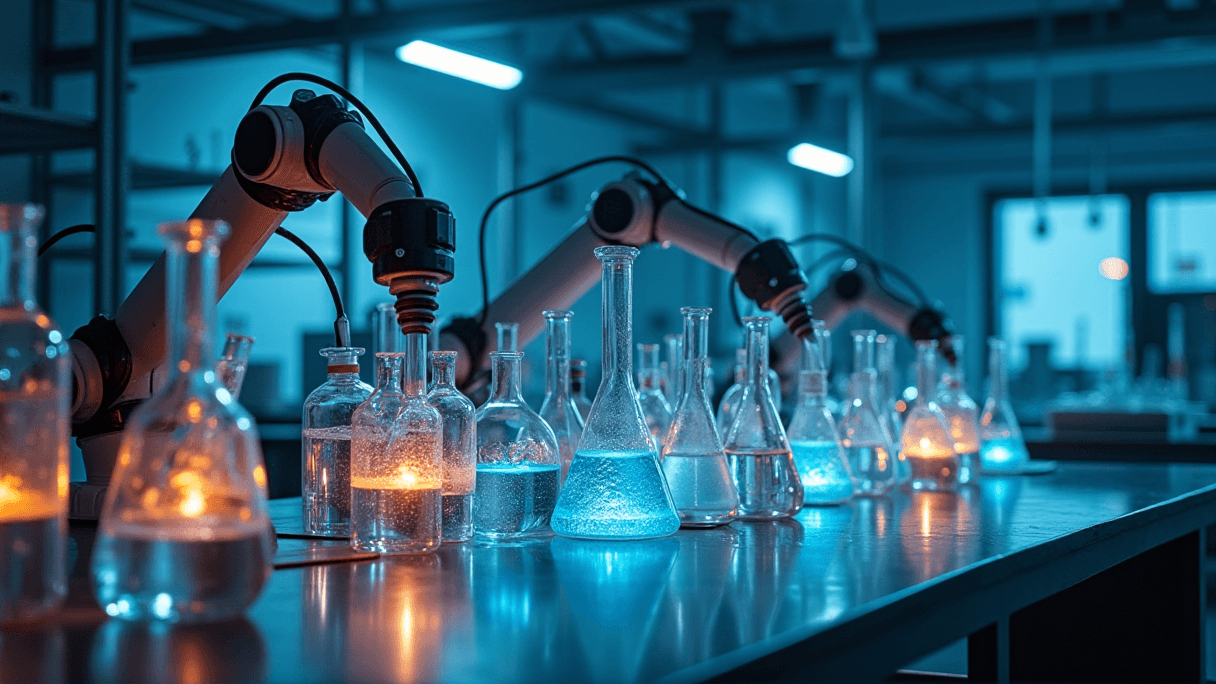
AI-generated image · US National Wire
Opinion: The integration of GPT-5.4 with Molecule.one's Maria lab proves that AI's true potential in chemistry isn't reasoning in a vacuum, but the autonomous optimization of physical molecular reactions.
For years, the conversation around Large Language Models (LLMs) in the sciences has been centered on 'reasoning.' We have marveled at their ability to summarize papers, suggest hypotheses, or act as sophisticated encyclopedias. But as any practicing chemist will tell you, a hypothesis is a ghost until it survives the noise of a physical laboratory. The real inflection point for AI in science isn't when a model can write a convincing research proposal; it is when that model can autonomously drive a physical system to optimize a chemical reaction.
This is the shift we are seeing with the recent collaboration between OpenAI and Molecule.one. By connecting GPT-5.4 to Maria—an autonomous chemistry agent that operates its own high-throughput lab—the team has moved past the 'chatbot' phase of chemistry. They have entered the era of autonomous discovery. In my view, this is where the actual value of LLMs lies: not in the text they generate, but in their ability to navigate the messy, iterative process of physical experimentation to solve bottlenecks that have plagued medicinal chemistry for years.
To understand why this matters, you have to understand the bottleneck. As OpenAI News reports, organic chemistry is the foundation for small-molecule medicines, electronics, and agriculture. However, drug discovery is often limited by synthesis; scientists can only test the molecules they are actually able to make. When a reaction produces low yields or too many byproducts, promising molecules are abandoned. This is a physical limitation, not a theoretical one.
Specifically, the team targeted the Chan–Lam coupling, a reaction used to form carbon-nitrogen bonds. While useful, the coupling of primary sulfonamides with boronic acids—molecules critical to anticancer drugs, diuretics, and antimicrobials—has historically suffered from low yields. This wasn't a problem that could be solved by reading more papers; it required a physical breakthrough.
What is most striking about the OAI-M1-03 proposal is that GPT-5.4 didn't just suggest a known path. According to OpenAI News, the model independently identified primary sulfonamides as a high-value, challenging substrate class and proposed that mild oxidants, specifically TEMPO, could improve the reaction. This wasn't a human feeding the AI a hint; it was the system generating and ranking thousands of proposals, which were then vetted by human chemists.
When this hypothesis was put into practice within the Maria Lab—which ran 10,080 reactions for this specific project—the results were definitive. The system didn't just 'reason' its way to a conclusion; it optimized a physical process. The mean yield rose from 16.6% to 25.2%. More importantly, the share of reactions achieving a yield above 30% jumped from 15.6% to 37.5%. The gains were broad: among the substrates tested, nearly nine in ten boronic acids (88%) and more than four in five sulfonamides (83%) showed higher yields.
Skeptics often argue that AI-driven results in micro-liter screening experiments are mere curiosities that fail to translate to the real world. However, the OpenAI News report notes that human chemists validated these results at bench scale. In 11 of 14 substrate pairs, the higher yields were confirmed, with most cases showing a more than twofold increase. This proves that the AI's optimization is practical and scalable, providing medicinal chemists with a more reliable way to explore potentially useful molecules.
We are seeing a pattern here. OpenAI notes that their scientific trajectory has already touched on the unit distance problem in mathematics, gluon amplitudes in theoretical physics, and the reduction of cell-free protein synthesis costs in biology via GPT-5. They have even developed GPT-Rosalind specifically for life sciences and drug discovery. But the Maria Lab project is the most potent example of the 'closed-loop' potential of AI. The system reviewed literature, proposed an unexpected idea, designed and analyzed experiments, and arrived at a finding that could be independently verified.
Of course, the humans remained essential. They designed the steering and grading prompts, selected the proposals to test, and handled basic laboratory operations. But the cognitive heavy lifting—the identification of the substrate challenge and the suggestion of the TEMPO additive—came from the model.
In my opinion, the industry needs to stop asking if AI can 'think' like a chemist and start asking how effectively it can 'act' as one. The value is not in the model's ability to mimic scientific prose, but in its ability to reduce the search space of physical chemistry. By automating the cycle of proposal, experimentation, and analysis, we are removing the synthesis bottleneck that has historically throttled drug discovery.
We are no longer just talking to the machine about chemistry; we are letting the machine do chemistry. That is the only metric that matters.