
AI Unlocks Lost Theorems in Kurt Gödel’s Private Notebooks

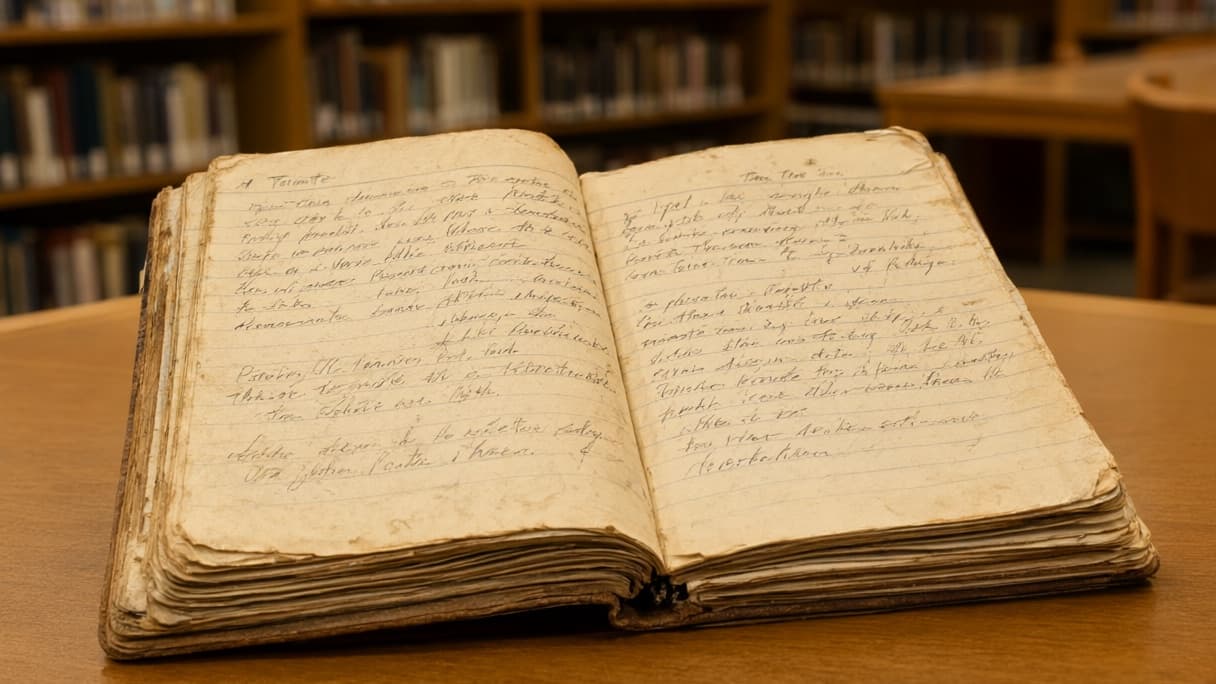
AI-generated image · US National Wire
The use of the AI model Claude to analyze 1,009 pages of obsolete shorthand has revealed hundreds of unknown mathematical proofs by the 20th-century logician.
A project led by Finnish logician Jan von Plato at Helsinki University has utilized artificial intelligence to decode the hidden mathematical discoveries of Kurt Gödel, one of the most influential thinkers of the 20th century. As first reported by The Guardian, the effort focused on 16 notebooks from the early 1940s containing 1,009 pages of dense text, much of which was written in Gabelsberger, a German shorthand that was largely obsolete even during Gödel's lifetime.
Von Plato, who is one of only six people globally capable of reading the shorthand, began the project in 2017 after receiving a grant of €2.5m (£2.1m) from the European Research Council. For years, human progress through the material was slow, averaging roughly one page per week. However, after meeting with computer scientists at a conference in France, von Plato integrated the AI model Claude into the workflow. By providing Claude with transcriptions of the workbooks, six of von Plato's own books on Gödel, and other secondary scientific literature, the AI produced a 650-page explanation of the material in just a few days.
The resulting analysis revealed that Gödel had proved hundreds of theorems previously unknown to the scientific community. Von Plato noted that the workbooks contain dozens of anticipations of results that were not discovered until the 1970s and 1980s, as well as 14 logic themes that have remained unpursued. Von Plato described the AI's ability to synthesize the 1,000-page corpus as a task impossible for humans, who struggle to maintain the necessary context across such a vast volume of text.
One specific application of the AI involved a long-standing mathematical dispute. In 1966, Paul Cohen won the Fields medal for proving the independence of the axiom of choice and the continuum hypothesis. At the time, Gödel claimed he had already proved the result in the 1940s but could not reconstruct the proof from his notes. When von Plato tasked Claude with finding the proof in the workbooks, the AI determined that Gödel was nearly successful. Von Plato stated that while Gödel had one definition wrong, he had possessed the correct definition two years prior, suggesting he was only a few months of work away from the completed proof.
Gödel, who famously authored the incompleteness theorems in 1931 and inspired Alan Turing's 1936 paper on modern computation, spent his later years at the Institute of Advanced Study in Princeton, New Jersey, where he was a close friend of Albert Einstein. In 1978, he passed away from starvation.